A CRM decays the day it ships. Reps skip fields, stages go stale, duplicates multiply. The fix is not more discipline — it is an automation layer that repairs the data continuously.
The five automations that pay first
- Deduplicate on entry — before the record is ever saved
- Auto-assign owner by territory and round-robin
- Stale-stage sweeps: no activity in 14 days → task, not silence
- Enrich from email signatures: phone, role, company size
- Nightly audit report to a channel, not to nobody
Clean CRM data is also the fuel for scoring — see Lead Qualification on Autopilot: Scoring and Routing with AI — and for every forecast your leadership team will ask about. If your pipeline lives in spreadsheets today, start with From Spreadsheet Chaos to Single Source of Truth instead. Contact for a CRM audit.
The landscape in numbers
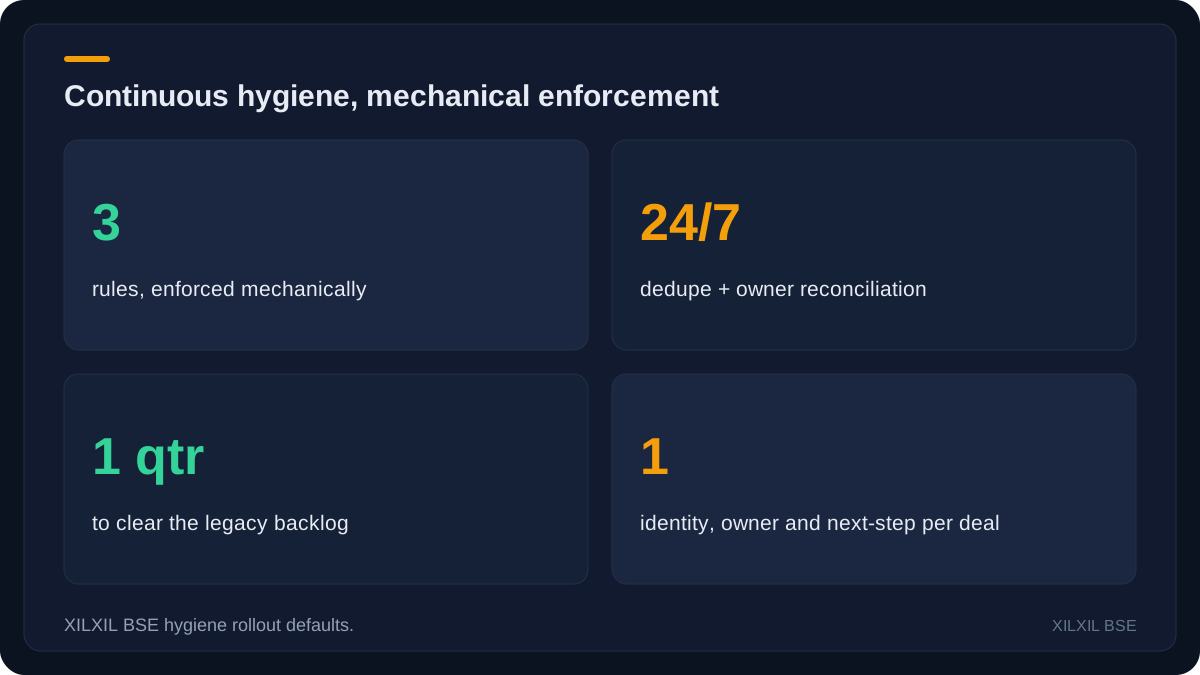
The panel below condenses CRM hygiene into the figures that actually move decisions — the same ones we put on client dashboards. Every value here is a clearly-labelled illustrative industry figure; the operative numbers for your business come from the baseline we instrument before any build starts (Measuring Automation ROI: The Metrics That Matter explains that discipline).
Why your dashboard lies (a little, every day)
Pipeline forecasts are only as honest as the records beneath them. Duplicates split history across three identities; stale owners keep dead deals alive; missing next-steps turn the forecast into fiction. None of this is a discipline failure — it is the predictable result of asking busy humans to do data entry with no guardrails.
Automation changes the economics of hygiene. Deduplication, ownership reconciliation and next-step enforcement become continuous background processes instead of a quarterly cleanup sprint everyone dreads. The CRM stops being a graveyard of intentions and starts being an instrument you can read at a glance.
The hygiene rules that matter
Start with three rules and enforce them mechanically. One identity per customer — a deterministic merge service with a human review queue for ambiguous matches. One owner per record — reconciled on every assignment, with orphaned records routed to a queue, not the void. One next-step per open deal — deals without a dated next step age visibly on the dashboard until they are fixed or closed.
Everything else — field completeness scoring, stage-ageing alerts, duplicate-prevention at entry — layers on top of those three. Teams that start with a forty-rule policy enforce none of them; teams that start with three enforced rules earn the right to add more.
Migration without the mutiny
Hygiene projects fail politically when they arrive as accusations (“you are the reason the data is bad”). The rollout that works is invisible enforcement plus visible wins: dedupe silently, then show the sales team a clean Monday-morning report where their biggest account is one record instead of four.
Give the team one quarter of grace: the automation enforces new-entry standards strictly, but legacy records are repaired progressively. By week twelve the backlog is gone, and nobody remembers exactly when the quarterly cleanup sprint stopped being necessary.
A rollout that survives contact with reality
Resist the big-bang. The sequence that works for CRM hygiene: weeks one and two, run a small pilot on a single workflow with the old process still running alongside — the side-by-side comparison is the evidence that convinces everyone else. Weeks three and four, integrate with the surrounding systems and let the weekly review tune whatever the pilot exposed. From week six, scale to the rest of the team using the playbook the pilot produced.
Two guardrails keep the rollout honest. First, a named owner with the authority to change the process — automations without owners drift, and drift is how quiet failures start. Second, an explicit success metric agreed before the pilot begins, with the dashboard from Measuring Automation ROI: The Metrics That Matter keeping it visible from day one. With those two in place, scaling becomes a series of small, reversible decisions instead of one large bet.
The three rules and their enforcement
Copy these columns into your own rollout doc — they are the whole policy.
| Rule | Mechanical enforcement | Human’s job |
|---|---|---|
| One identity per customer | Deterministic merge service | Review ambiguous matches |
| One owner per record | Reconcile on assignment; orphans queued | Claim orphans weekly |
| One dated next-step per open deal | Ageing badge on the dashboard | Close or re-commit the deal |
The data, visualised
Charts beat adjectives. The figures below are drawn from the illustrative dataset behind this article — treat the shapes as the lesson, and replace the placeholder values with your own baseline when the work starts.
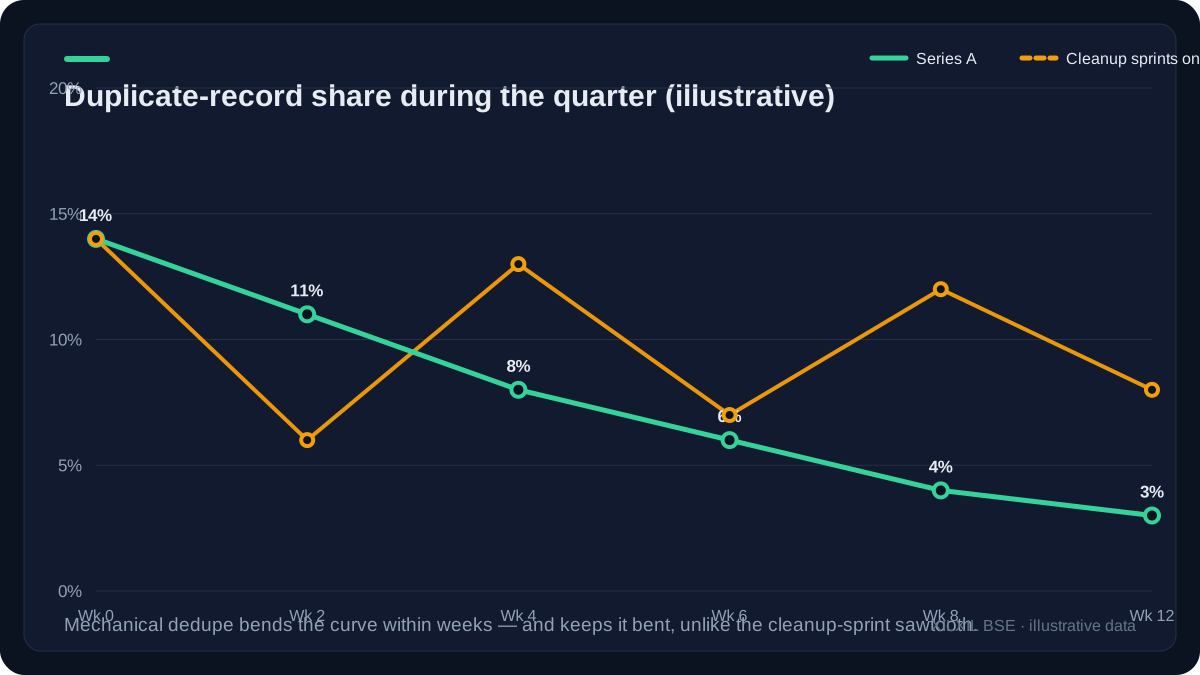
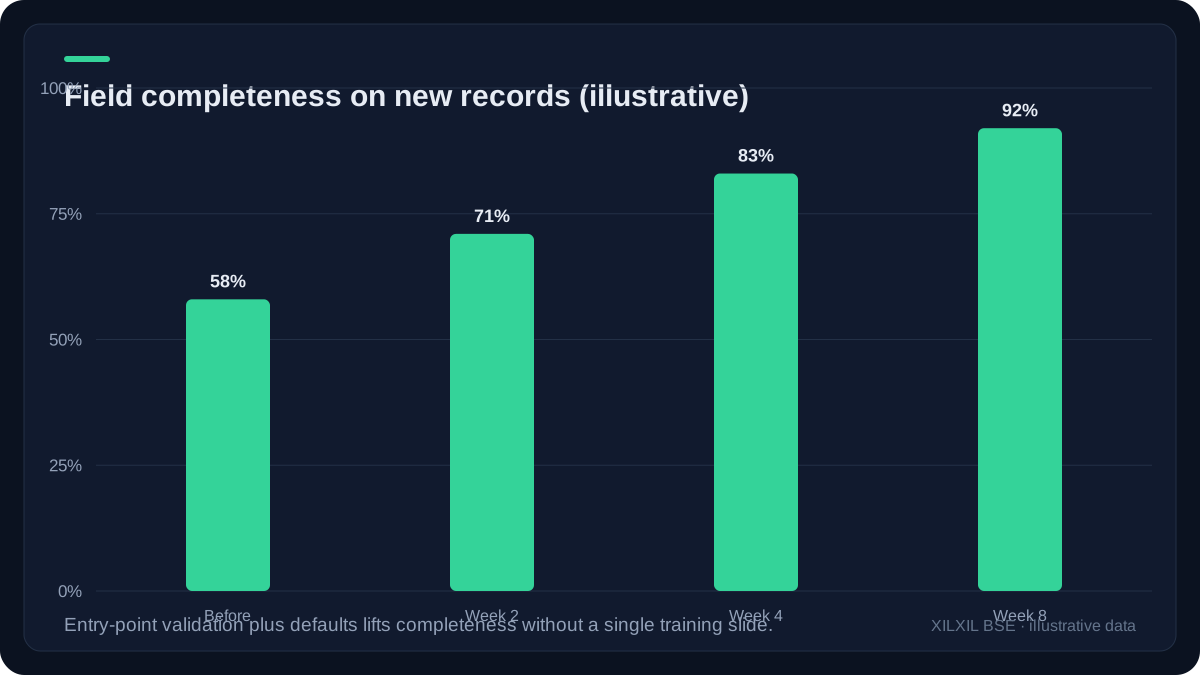
Hygiene is not a discipline problem — it is an economics problem, and automation changes the economics.
Key takeaways
- Dashboards lie exactly as much as the records beneath them.
- Start with three enforced rules, not a forty-line policy nobody reads.
- Enforce mechanically at entry; never ask willpower to do what a default can do.
- Repair the legacy backlog progressively — one quarter of grace buys a decade of clean data.
- Show visible wins early; invisible enforcement plus clean Mondays beats memos.
Frequently asked questions
Which CRMs does this work on?
HubSpot, Pipedrive, Zoho and Salesforce are the usual suspects; the rules are platform-agnostic and implemented as services around the CRM’s API. Spreadsheet-based CRMs get a migration path first.
Will auto-merge ever merge the wrong customers?
Deterministic matches (identical phone/email after normalisation) merge automatically; fuzzy matches queue for a human click. The review queue is deliberately boring — that is what keeps it accurate.
How do we stop duplicates at the door?
Entry-point checks block exact matches, warn on near-matches, and normalise phone and email formats on save. Most duplicate creation stops the week the gate goes live.
Is this a one-time cleanup or ongoing?
Both, in that order: a fixed-scope cleanup establishes the baseline, and the automation keeps it clean. From Spreadsheet Chaos to Single Source of Truth covers the data-layer groundwork this assumes.
Conclusion & next steps
That is the full picture: the context, the decisions, and the numbers behind CRM hygiene. If one sentence should survive this read, it is this — preparation compounds. Measure the baseline, make the process legible, then automate deliberately and review monthly; that sequence works for revenue operations leads in your pipeline and everywhere else.
Want your Monday report to finally add up? Contact for a free CRM health check — Pricing shows the cleanup package.
Picking tools for the job? Our honest, data-backed reviews live at Top AI Tools 2025 (SaaS & AI platforms) and Smart Home Picks (hardware worth the dirham) — illustrative benchmarks, clearly labelled, and never pay-to-play rankings.