A generic chatbot guesses. A grounded chatbot answers from your documents, policies and product catalogue — and says “I don’t know” when the answer is not there. The technique is retrieval-augmented generation (RAG), and it is the difference between a demo and a deployable agent.
The three moving parts
- Index: your PDFs, pages and tickets are chunked and embedded
- Retrieve: each question pulls the few relevant passages
- Answer: the model writes from those passages, with citations
Where projects go wrong
Garbage in, confident nonsense out. Stale pricing sheets and duplicate documents poison the index — the same discipline as From Spreadsheet Chaos to Single Source of Truth. Permissions matter too: the agent must respect who may see what, especially for HR and finance content.
Start with one document set, measure answer accuracy for two weeks, then expand. We build RAG agents on your own stack — Contact to scope one.
The landscape in numbers
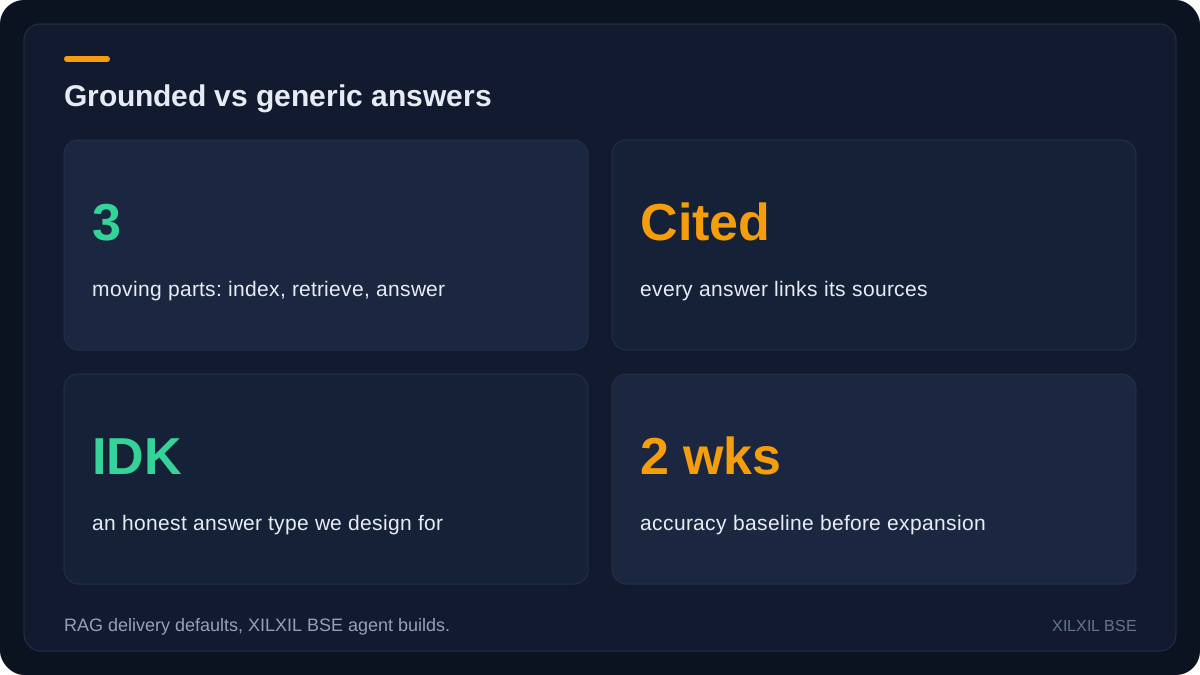
The panel below condenses retrieval-augmented generation into the figures that actually move decisions — the same ones we put on client dashboards. Every value here is a clearly-labelled illustrative industry figure; the operative numbers for your business come from the baseline we instrument before any build starts (Measuring Automation ROI: The Metrics That Matter explains that discipline).
Grounding changes the failure mode
An ungrounded language model fails confidently — it produces fluent, plausible nonsense, which is the most dangerous kind of wrong answer in a business context. A grounded (RAG) system fails honestly: when retrieval finds nothing relevant, the agent says so and routes to a human. You are not making the model smarter; you are giving it evidence and permission to abstain.
That shift is why RAG agents survive contact with real customers while wrapper demos get shelved. The measurable difference is answer accuracy against your own documents — and the honest “I don’t know” that preserves trust when the document set genuinely does not cover a question.
The index is the product
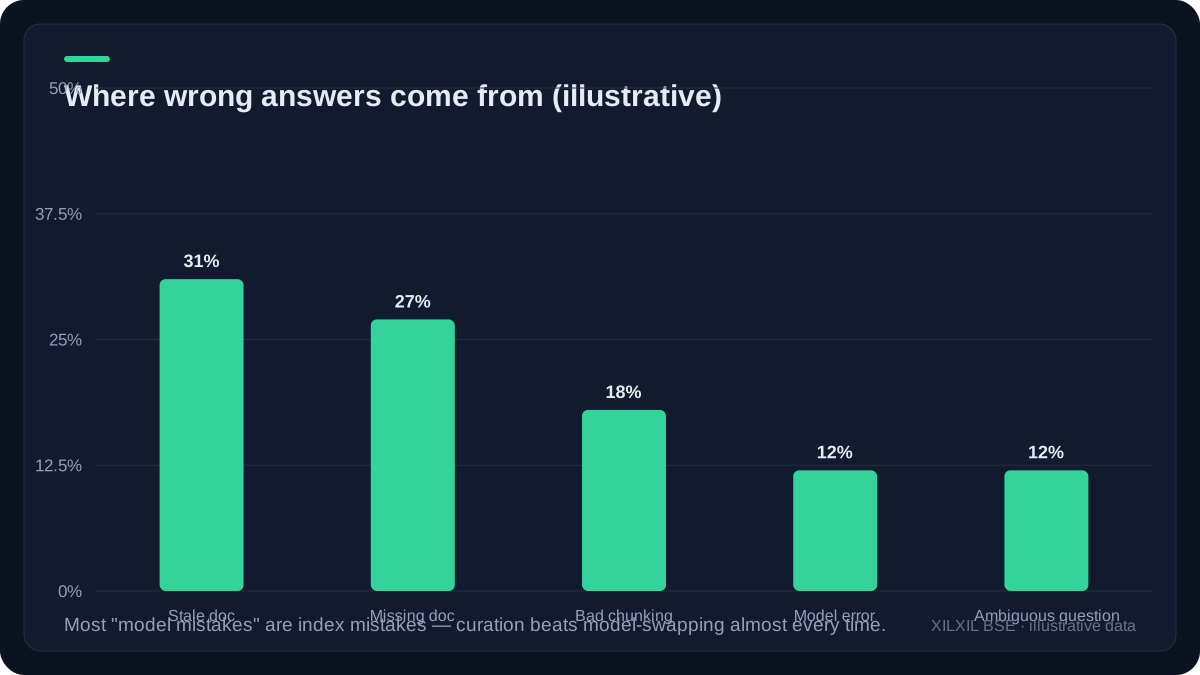
Teams obsess over models and neglect the index, which is where accuracy is actually won. Chunking strategy, metadata (document type, effective date, owner) and deduplication decide whether retrieval finds the right passage. A stale pricing PDF in the index is worse than a missing one — the agent will quote the wrong price with perfect confidence.
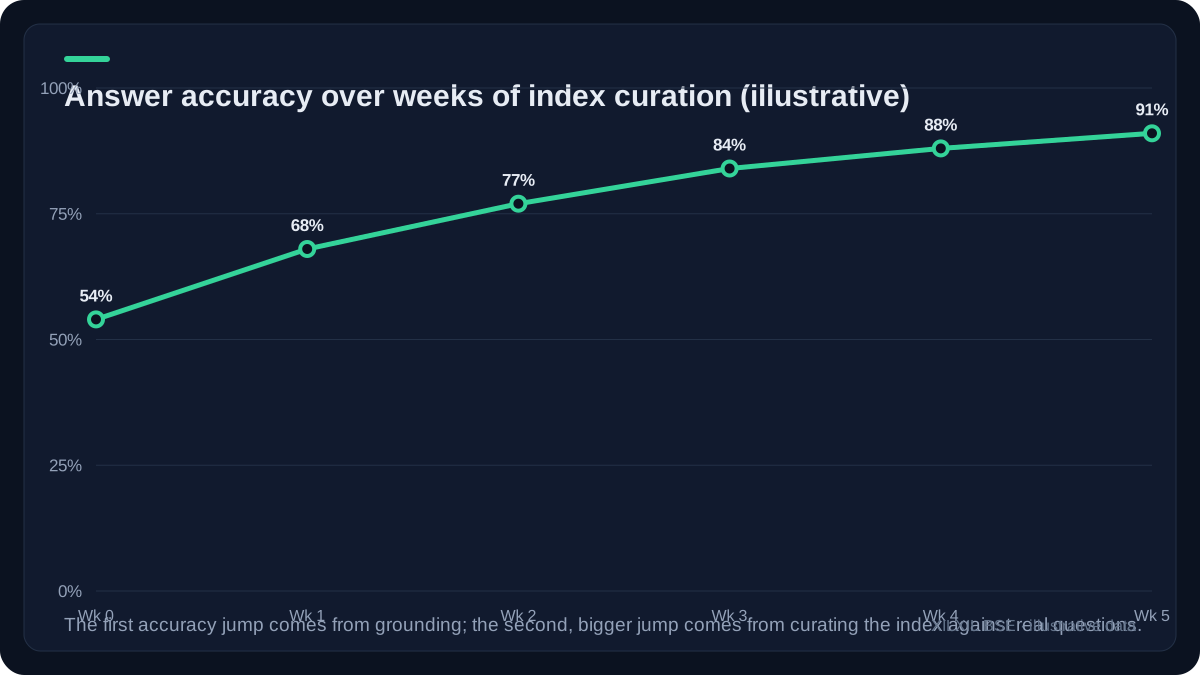
Treat the index like a garden: scheduled re-ingestion, expiry rules for dated documents, and a review log of every answer that was wrong in production. After two weeks of that loop, accuracy gains come from curation, not from swapping models.
Permissions are part of retrieval
The agent must answer as the person asking — an HR policy document visible to managers must not surface to interns through the back door of a chat window. Permission-aware retrieval filters passages by the asker’s access level before generation, and audit logs record which documents informed which answer.
This is build-time work, not a configuration toggle, and it is the first thing we scope in regulated environments. The pattern generalises: finance content, contracts and anything with personal data all inherit the same access rules their source systems already enforce.
A rollout that survives contact with reality
Resist the big-bang. The sequence that works for retrieval-augmented generation: weeks one and two, run a small pilot on a single workflow with the old process still running alongside — the side-by-side comparison is the evidence that convinces everyone else. Weeks three and four, integrate with the surrounding systems and let the weekly review tune whatever the pilot exposed. From week six, scale to the rest of the team using the playbook the pilot produced.
Two guardrails keep the rollout honest. First, a named owner with the authority to change the process — automations without owners drift, and drift is how quiet failures start. Second, an explicit success metric agreed before the pilot begins, with the dashboard from Measuring Automation ROI: The Metrics That Matter keeping it visible from day one. With those two in place, scaling becomes a series of small, reversible decisions instead of one large bet.
Good index candidates vs bad ones
Start where grounding pays fastest — the documents everyone keeps re-reading.
| Document set | Grounding value | Watch out for |
|---|---|---|
| Product catalogue + pricing | High — kills wrong-price answers | Version control, effective dates |
| HR policy handbook | High — consistent answers | Permission tiers per role |
| Support macros + tickets | High — reuses proven answers | PII redaction before indexing |
| Raw meeting notes | Low — contradictory and stale | Better as summarised decisions |
| Marketing PDFs | Medium | Claims drift from actual T&Cs |
The data, visualised
Charts beat adjectives. The figures below are drawn from the illustrative dataset behind this article — treat the shapes as the lesson, and replace the placeholder values with your own baseline when the work starts.
You are not making the model smarter — you are giving it evidence, citations, and permission to say “I don’t know”.
Key takeaways
- Grounding changes the failure mode from confident nonsense to honest abstention.
- The index, not the model, is where accuracy is won — treat it like a garden.
- Metadata and expiry rules beat bigger models almost every time.
- Permission-aware retrieval is mandatory for HR and finance content.
- Baseline accuracy for two weeks on one document set before expanding scope.
Frequently asked questions
Do we need a vector database?
Not necessarily to start. For most SME document volumes, pgvector on your existing Postgres or a managed store is plenty. The index design matters more than the storage engine.
How do you stop it quoting a stale price?
Effective-dating: every indexed document carries metadata for validity, expired versions are excluded at retrieval time, and pricing pages are re-ingested on a schedule tied to your update process.
Can it answer across departments safely?
Yes, with permission-aware retrieval — passages are filtered by the asker’s access level before generation, and every answer’s source list is logged for audit.
How is this different from the chatbots on your services page?
Contact scopes RAG as one flavour of agent build — the demos at Demo Projects include a grounded catalogue assistant you can try live.
Conclusion & next steps
That is the full picture: the context, the decisions, and the numbers behind retrieval-augmented generation. If one sentence should survive this read, it is this — preparation compounds. Measure the baseline, make the process legible, then automate deliberately and review monthly; that sequence works for knowledge-operations leads in your organisation and everywhere else.
Have a document set that everyone keeps re-reading? Contact to scope a grounded agent — Pricing shows what a fixed-scope pilot includes.
Picking tools for the job? Our honest, data-backed reviews live at Top AI Tools 2025 (SaaS & AI platforms) and Smart Home Picks (hardware worth the dirham) — illustrative benchmarks, clearly labelled, and never pay-to-play rankings.