
Every enquiry is not equal. An AI qualification layer reads each lead — form, chat, call or WhatsApp — scores it against your best-customers profile, and routes it: hot to a phone, warm to a sequence, cold to a newsletter.
Signals worth scoring
- Firmness: budget, timeline and authority stated explicitly
- Fit: industry, size and geography against your winning profile
- Behaviour: pages read, demos opened, replies answered
Routing rules that survive reality
Scores decay — a lead hot last week is warm today. Routing must include the boring cases: duplicates, existing customers and internal tests. And every score lands in the CRM with its reasoning attached, which keeps CRM Hygiene: Automate the Fields Everyone Forgets honest.
Fixed-scope build: scoring model, routing flows and a weekly accuracy review. Numbers in Pricing — or Contact to map your lead sources first.
The landscape in numbers
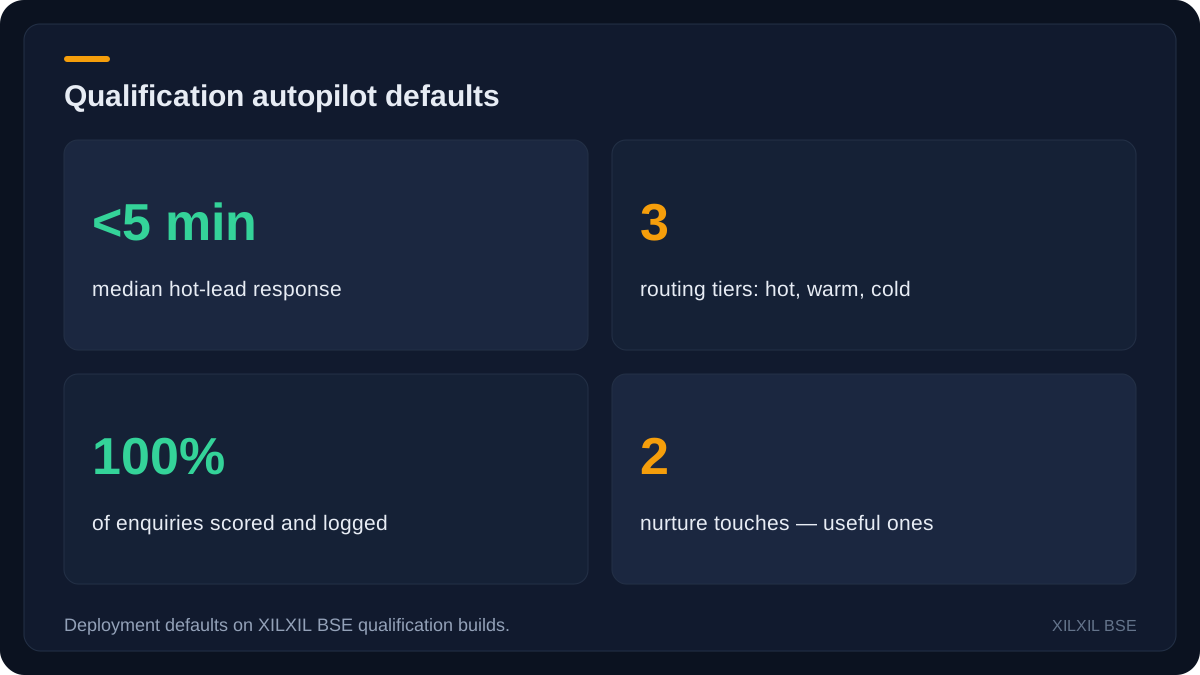
The panel below condenses lead qualification into the figures that actually move decisions — the same ones we put on client dashboards. Every value here is a clearly-labelled illustrative industry figure; the operative numbers for your business come from the baseline we instrument before any build starts (Measuring Automation ROI: The Metrics That Matter explains that discipline).
Scoring is a routing decision, not a grade
The purpose of a lead score is not to rank humans; it is to decide who hears from whom, how fast, and through which channel. Our scoring model answers one question — should a expensive human touch this right now — and every field it uses must be collectable inside the first conversation, not guessed from firmographic astrology.
Behaviour beats declarations. A prospect who opened the pricing page twice this week and replied within an hour is telling you their urgency; a form field claiming a budget number is telling you nothing. The scoring engine weighs live behaviour heavily and lets stated facts tip ties, not carry the decision.
The autopilot loop
Enquiry lands → enriched against CRM history → scored on behaviour and fit → routed: hot leads ring a phone within minutes, warm leads enter a two-touch nurture with genuinely useful content, cold leads get a polite close and a reason to return. Every step is logged, so the score itself is auditable and tunable.
The loop’s quiet superpower is follow-up discipline. Autopilots do not forget Fridays. The two-touch nurture fires exactly when designed, and the hot-lead alert fires exactly once — because the alternative, three salespeople calling the same lead in an afternoon, is how small teams teach prospects to stop answering.
What changes in week one
Response-time distribution collapses: from a bimodal mess (instant for whoever noticed, next-day for the rest) to a tight median under five minutes. Sales hours go to conversations with scored, pre-warmed prospects instead of triage. And the pipeline report finally means something, because every lead carries the same qualification taxonomy.
Expect the uncomfortable insight too: a meaningful share of “hot” historical leads were never qualified at all — they were loud. The autopilot does not create demand; it makes the demand you already have legible.
A rollout that survives contact with reality
Resist the big-bang. The sequence that works for lead qualification: weeks one and two, run a small pilot on a single workflow with the old process still running alongside — the side-by-side comparison is the evidence that convinces everyone else. Weeks three and four, integrate with the surrounding systems and let the weekly review tune whatever the pilot exposed. From week six, scale to the rest of the team using the playbook the pilot produced.
Two guardrails keep the rollout honest. First, a named owner with the authority to change the process — automations without owners drift, and drift is how quiet failures start. Second, an explicit success metric agreed before the pilot begins, with the dashboard from Measuring Automation ROI: The Metrics That Matter keeping it visible from day one. With those two in place, scaling becomes a series of small, reversible decisions instead of one large bet.
Scoring signals that survive contact with reality
Weight live behaviour over stated facts — these are the signals we default to.
| Signal | Weight | Why it works |
|---|---|---|
| Pricing page repeat visits | High | Buying intent, self-declared by behaviour |
| Reply latency | High | Urgency mirrors their own clock |
| Service-line match | High | Fit beats volume |
| Stated budget band | Low | Self-reported, rarely accurate |
| Company size (public) | Low | Tie-breaker only |
The data, visualised
Charts beat adjectives. The figures below are drawn from the illustrative dataset behind this article — treat the shapes as the lesson, and replace the placeholder values with your own baseline when the work starts.
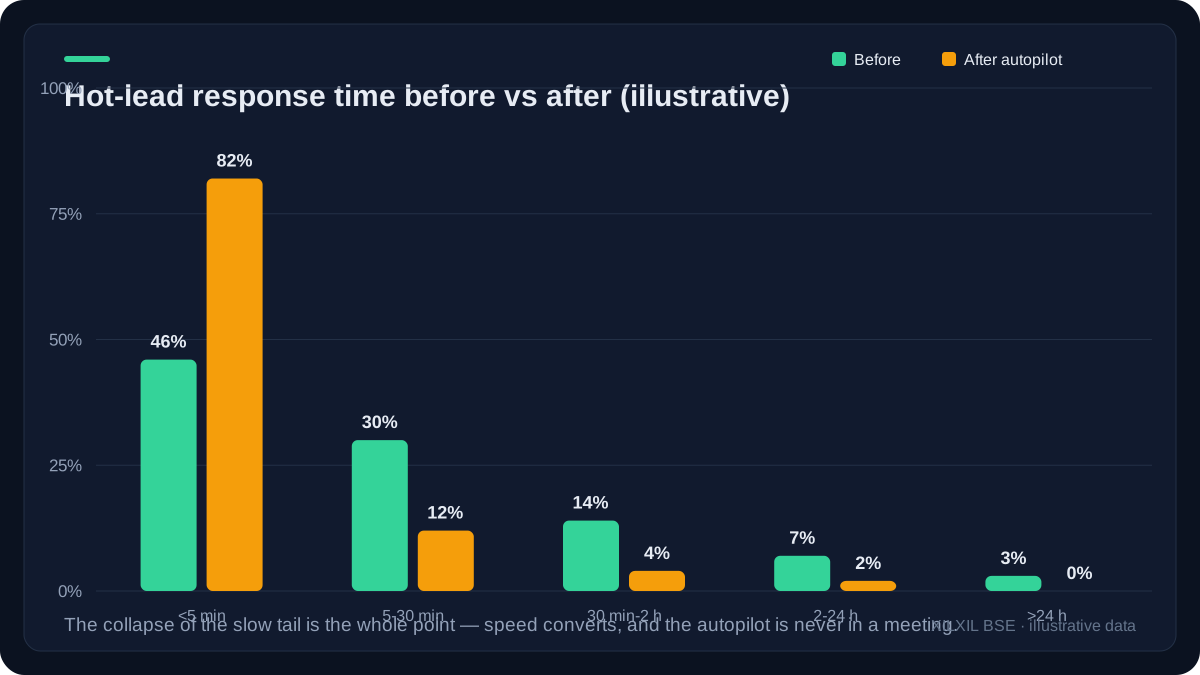
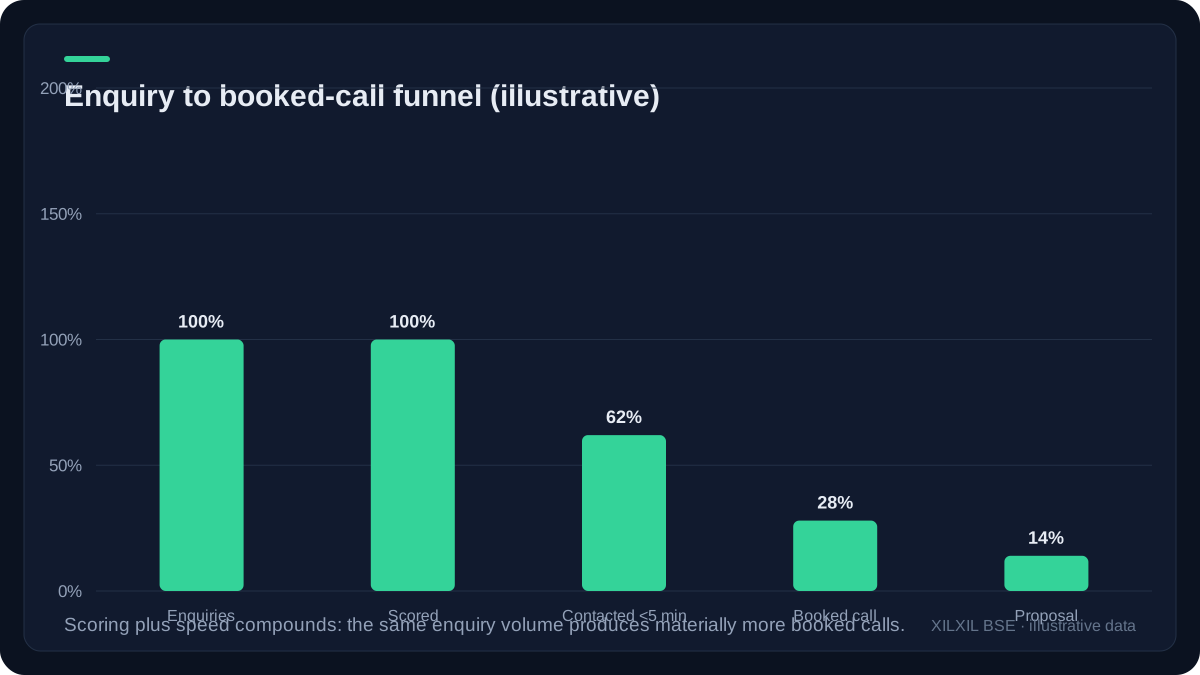
The autopilot does not create demand — it makes the demand you already have legible, and fast.
Key takeaways
- A lead score exists to route touches, not to grade people.
- Weight live behaviour (visits, latency) over self-reported form fields.
- Hot leads ring a human in minutes; warm leads nurture twice; cold leads close politely.
- One alert, one caller — duplicated outreach teaches prospects to stop answering.
- Publish the response-time histogram; it is the metric that predicts revenue.
Frequently asked questions
Does this work with our existing CRM?
Yes — the autopilot sits beside your CRM and writes scored, routed, logged leads into it. HubSpot, Pipedrive, Zoho and plain spreadsheets are all supported starting points.
How long until scoring is trustworthy?
The rule-based tier works from day one. behavioural weights are tuned after two to four weeks of real data — we publish the tuning log, so the model never changes silently.
Will it spam cold leads?
No — cold leads get one polite close with a genuinely useful resource and a re-entry path. The autopilot’s job is protecting your team’s hours, including from prospects who are not a fit yet.
What does this cost to run?
It is one fixed-scope build plus modest per-message infrastructure. Pricing shows the package structure — most clients see it pay for itself inside the first scored quarter.
Conclusion & next steps
That is the full picture: the context, the decisions, and the numbers behind lead qualification. If one sentence should survive this read, it is this — preparation compounds. Measure the baseline, make the process legible, then automate deliberately and review monthly; that sequence works for sales leads in your pipeline and everywhere else.
Bring your last hundred enquiries — Contact and we will show you what the autopilot would have scored and routed, free.
Picking tools for the job? Our honest, data-backed reviews live at Top AI Tools 2025 (SaaS & AI platforms) and Smart Home Picks (hardware worth the dirham) — illustrative benchmarks, clearly labelled, and never pay-to-play rankings.