A shared inbox treats an outage report and a password reset with the same urgency. An AI triage layer classifies every incoming message in seconds, sets the priority and routes it — so the SLA clock starts on the right ticket.
The triage rules
- Classify: issue type, product area, sentiment, language
- Prioritize: severity and contract tier beat arrival order
- Route: the right team first time — no reassignment ping-pong
- Draft: the AI proposes a first reply; a human approves
Keeping humans in the loop
Auto-replies are drafts until your team approves them — the boundary from When NOT to Automate: Human-in-the-Loop by Design. Containment and first-response times feed the same scorecard as Measuring Automation ROI: The Metrics That Matter, so the improvement is visible weekly.
Support triage is one of our most-requested fixed-scope builds. Baseline your inbox with us — Contact.
The landscape in numbers
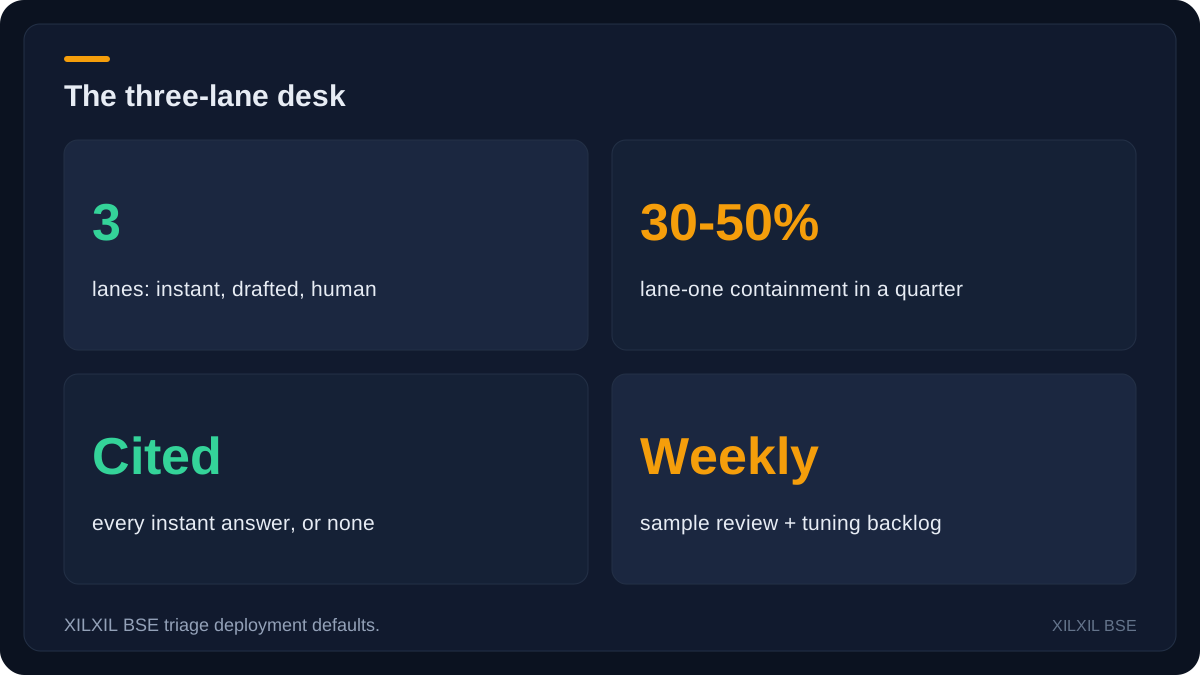
The panel below condenses AI support triage into the figures that actually move decisions — the same ones we put on client dashboards. Every value here is a clearly-labelled illustrative industry figure; the operative numbers for your business come from the baseline we instrument before any build starts (Measuring Automation ROI: The Metrics That Matter explains that discipline).
Triage is routing, not answering
The highest-ROI AI in support is not the one writing replies — it is the one reading every ticket in seconds and deciding three things: what is this about, how urgent is it really, and who should own it. Done well, this is invisible; your team simply starts the day with clean lanes instead of a shuffled queue.
Urgency classification is where generic implementations fail. “URGENT!!!” in the subject line means nothing; a silent churning customer on their third ticket means everything. The triage model weighs sentiment trend, account value, SLA clock and topic — and sends genuinely angry premium customers to the front, not the loudest typist.
The three-lane desk
Lane one: instant answers. The FAQ-and-account-status tier resolved by the AI with citations, never guessing — anything uncertain falls through deliberately. Lane two: prepared replies for humans — the AI drafts, cites similar past tickets, and the agent reviews and sends. Lane three: complex or sensitive cases routed with a full summary to the senior desk.
The measurable outcome is not headcount reduction; it is first-response time collapsing and senior-expert time concentrating where it changes outcomes. Teams typically see lane-one containment of thirty to fifty percent within a quarter, with satisfaction flat or up — because fast, correct, honest beats slow and human every day of the week.
Trust is the product
Support automation lives or dies on trust, both directions. Customers trust it when it is honest about being a bot, cites its sources, and hands off gracefully. Agents trust it when its drafts are genuinely good and its mistakes are visible in review. Both trusts are built the same way: every AI action is logged, sampled and reviewed weekly.
The review loop produces the tuning backlog — new intents, tone fixes, escalation rules — and the metric dashboard keeps the conversation honest: containment, first-response, CSAT, hand-off quality. When CSAT dips, the loop finds why before the quarter review does.
A rollout that survives contact with reality
Resist the big-bang. The sequence that works for AI support triage: weeks one and two, run a small pilot on a single workflow with the old process still running alongside — the side-by-side comparison is the evidence that convinces everyone else. Weeks three and four, integrate with the surrounding systems and let the weekly review tune whatever the pilot exposed. From week six, scale to the rest of the team using the playbook the pilot produced.
Two guardrails keep the rollout honest. First, a named owner with the authority to change the process — automations without owners drift, and drift is how quiet failures start. Second, an explicit success metric agreed before the pilot begins, with the dashboard from Measuring Automation ROI: The Metrics That Matter keeping it visible from day one. With those two in place, scaling becomes a series of small, reversible decisions instead of one large bet.
What the triage model reads
Signal beats volume — these are the default inputs and their roles.
| Signal | Informs | Weight |
|---|---|---|
| Topic classification | Lane + skill routing | High |
| Sentiment trend (history) | Urgency escalation | High |
| Account value / SLA | Priority tier | Medium |
| Ticket age & repeats | Churn-risk flag | Medium |
| ALL-CAPS volume | Nothing | Zero — deliberately |
The data, visualised
Charts beat adjectives. The figures below are drawn from the illustrative dataset behind this article — treat the shapes as the lesson, and replace the placeholder values with your own baseline when the work starts.
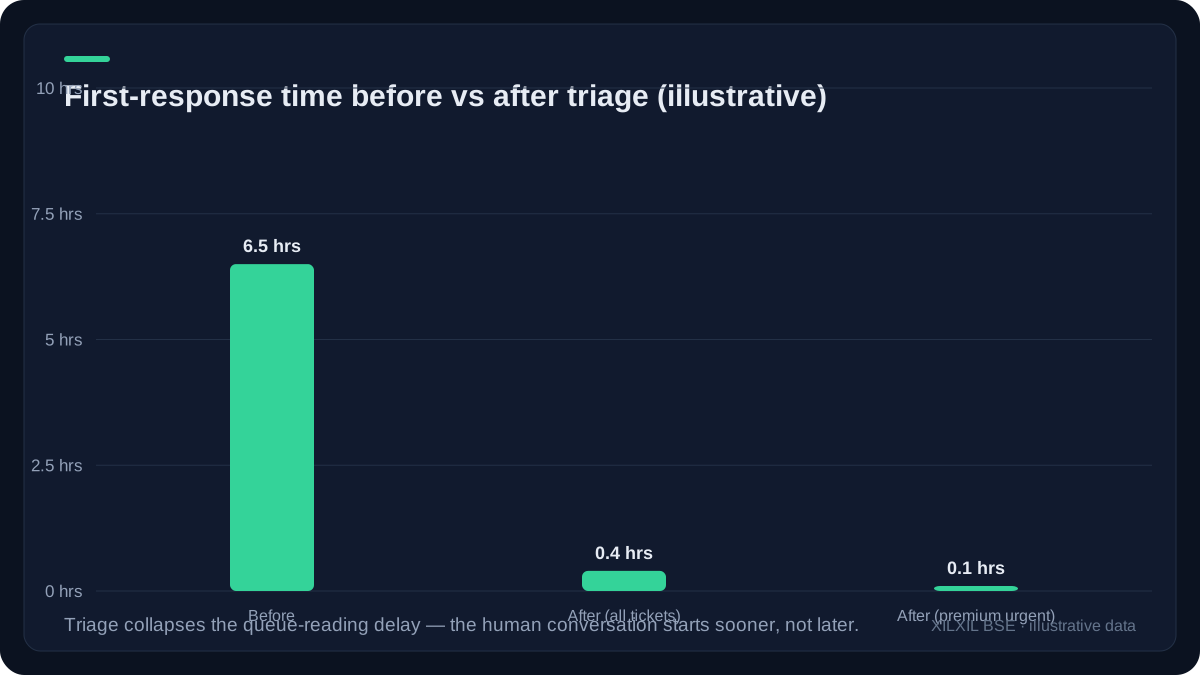

Fast, correct and honest beats slow and human every day of the week — and the citations prove it.
Key takeaways
- Triage first: classify, prioritise and route every ticket before any AI writes prose.
- Urgency comes from sentiment trend and account context, not exclamation marks.
- Three lanes: instant with citations, AI-drafted for human review, senior desk for complex.
- Containment targets of 30-50% are realistic within a quarter — with CSAT flat or up.
- Weekly sampling of AI actions is what keeps both customer and agent trust alive.
Frequently asked questions
Will it hallucinate answers to customers?
The lane-one design only answers from indexed, verified sources with citations; anything below the confidence threshold falls to lane two. Abstention is a designed behaviour, not an accident.
Does it work with our helpdesk?
Zendesk, Freshdesk, Intercom and plain shared inboxes are common integrations. Triage writes tags, priority and routing; your agents keep their tools.
How do agents react to AI drafts?
Sceptical for about a week, then protective of it. Drafts cite similar resolved tickets, so agents verify in seconds — and the review loop removes the bad patterns that erode trust.
What does containment exclude?
Complaints, refunds, legal and anything sensitive route straight to humans by policy. Containment is measured on the routine middle only — never by hiding the hard cases.
Conclusion & next steps
That is the full picture: the context, the decisions, and the numbers behind AI support triage. If one sentence should survive this read, it is this — preparation compounds. Measure the baseline, make the process legible, then automate deliberately and review monthly; that sequence works for support leads in your helpdesk and everywhere else.
Want the three-lane desk on your queue? Contact to trial triage on a sample of real tickets — Pricing shows the fixed-scope build.
Picking tools for the job? Our honest, data-backed reviews live at Top AI Tools 2025 (SaaS & AI platforms) and Smart Home Picks (hardware worth the dirham) — illustrative benchmarks, clearly labelled, and never pay-to-play rankings.