

We are an automation company, and regularly recommend NOT automating things. Automating a judgement call you do not understand just produces wrong answers at scale — with your brand on them.
The four tests
- Frequency: does it happen often enough to deserve a flow?
- Variability: do the inputs actually repeat, or is every case new?
- Cost of error: is a wrong answer recoverable — and who absorbs it?
- Trust: would a customer accept a machine decision here, today?
Fail two or more, and the right design is human-in-the-loop: the machine drafts, sorts and summarizes; the human decides. Escalation paths are part of every agent we ship — the hand-off discipline from WhatsApp AI Agent Playbook: From Missed Enquiry to Booked Job and the scorecard from Measuring Automation ROI: The Metrics That Matter both assume it.
Honest scoping is why our projects stay fixed-scope — sometimes the recommendation is training, not bots. Start that conversation at Contact.
The landscape in numbers
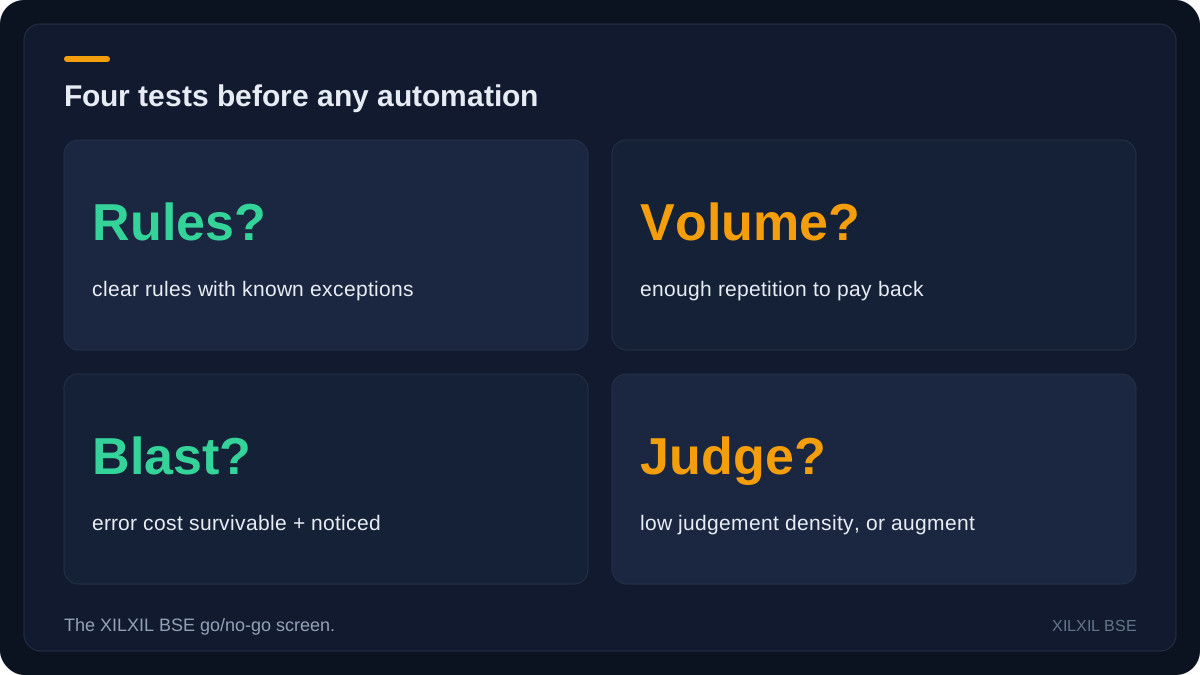
The panel below condenses what not to automate into the figures that actually move decisions — the same ones we put on client dashboards. Every value here is a clearly-labelled illustrative industry figure; the operative numbers for your business come from the baseline we instrument before any build starts (Measuring Automation ROI: The Metrics That Matter explains that discipline).
Automation has a worst-case, and it is not zero
The pitch deck says automation eliminates toil. The honest engineering doc says it can also industrialise mistakes: a flawed workflow executed perfectly, at speed, around the clock, with nobody watching. The worst case is not “no benefit” — it is a customer-facing failure loop that outlives the person who approved it.
Which is why the first question in our readiness audit is not “can this be automated” but “should it be”. Three tests decide: is the task rule-based (does it have real exceptions?), is it repeated enough to pay back, and is the cost of a wrong output survivable without a human noticing? Fail the third and you are automating risk, not toil.
The tasks that should stay human
Judgement under ambiguity: negotiations, escalations, anything where the relationship IS the task. Creative direction: automating the brief produces mediocrity at scale. Low-volume high-stakes: a monthly process with a five-figure error mode does not have enough repetitions to pay for its own safety rails. Trust-building moments: the apology, the exception, the personal favour — automating those converts customers into account numbers.
Note what is NOT on the list: drudgery around those tasks. Negotiating stays human; preparing the negotiation brief automates beautifully. The apology stays human; the incident timeline that informs it automates. Augment the human, automate around them — never instead of them.
The decision table we use
Every candidate process gets four columns: repetition count, rule clarity, error cost, and human-judgement density. High repetition + clear rules + low error cost = automate fully. High error cost = automate with mandatory review gates. High judgement density = augment, don’t replace. Low repetition = coach a person, or retire the task.
The table’s real value is political: it depersonalises the “no”. Nobody’s favourite project gets killed by a manager’s mood — it gets routed by criteria everyone saw beforehand. And the “no, but here is what we automate around it” answer keeps the programme credible.
A rollout that survives contact with reality
Resist the big-bang. The sequence that works for what not to automate: weeks one and two, run a small pilot on a single workflow with the old process still running alongside — the side-by-side comparison is the evidence that convinces everyone else. Weeks three and four, integrate with the surrounding systems and let the weekly review tune whatever the pilot exposed. From week six, scale to the rest of the team using the playbook the pilot produced.
Two guardrails keep the rollout honest. First, a named owner with the authority to change the process — automations without owners drift, and drift is how quiet failures start. Second, an explicit success metric agreed before the pilot begins, with the dashboard from Measuring Automation ROI: The Metrics That Matter keeping it visible from day one. With those two in place, scaling becomes a series of small, reversible decisions instead of one large bet.
Automate, augment, or leave human?
The routing table for every candidate — criteria first, opinions second.
| Task profile | Posture | Example |
|---|---|---|
| High volume, clear rules, low error cost | Automate fully | Invoice chasing, report generation |
| High error cost | Automate + review gates | Payments, publish actions |
| High judgement density | Augment the human | Negotiation briefs, escalation summaries |
| Low volume, high stakes | Leave human | Contracts, one-off decisions |
| Trust-building moments | Leave human, automate around | Apologies with prepared timelines |
The data, visualised
Charts beat adjectives. The figures below are drawn from the illustrative dataset behind this article — treat the shapes as the lesson, and replace the placeholder values with your own baseline when the work starts.
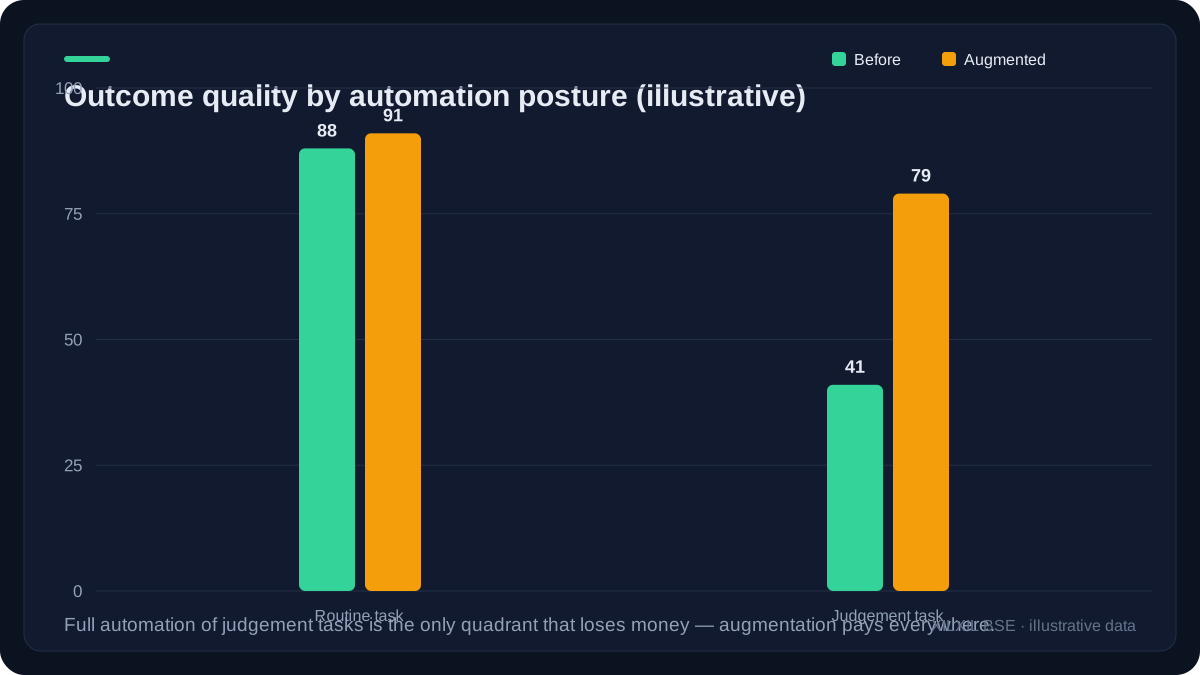
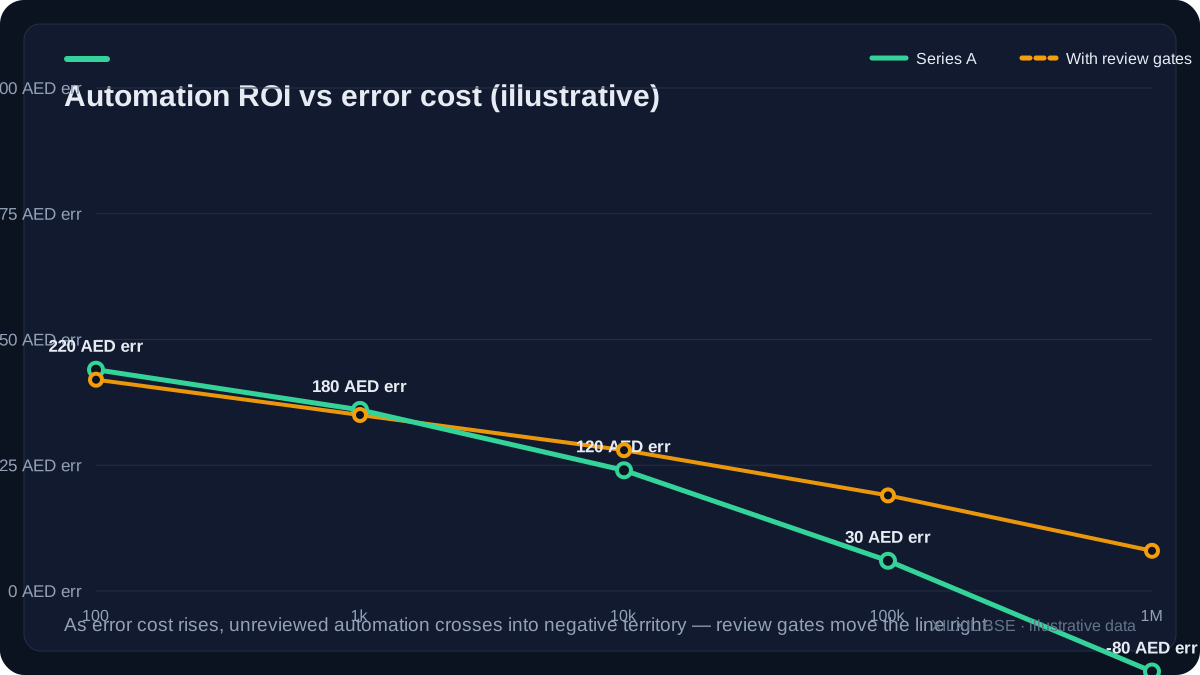
The worst case is not “no benefit” — it is a flawed workflow executed perfectly, at speed, forever.
Key takeaways
- Ask “should it be automated” before “can it be”.
- Judgement, creativity, trust moments and low-volume/high-stakes work stay human.
- Augment the human and automate around them — never instead of them.
- High error cost demands mandatory review gates, not more confidence.
- A transparent decision table depersonalises the “no” and keeps the programme credible.
Frequently asked questions
Is this just an excuse to sell smaller projects?
It is the reason our projects work. Recommending “not yet” on a bad-fit process costs us revenue today and saves the relationship — Automation Readiness Checklist is the same philosophy in checklist form.
Can judgement tasks become automatable later?
Sometimes — after instrumentation. Once decisions are logged with outcomes and the exception types are known, the automation boundary can move deliberately, not hopefully.
What are review gates in practice?
The automation prepares the action; a human approves in one click above a threshold you set. After a clean track record, thresholds rise — trust is earned by the log.
How do we tell a client “no” without losing them?
Route, don’t refuse: show the decision table, then automate the drudgery around the human task. The client gets value; nobody industrialises a mistake.
Conclusion & next steps
That is the full picture: the context, the decisions, and the numbers behind what not to automate. If one sentence should survive this read, it is this — preparation compounds. Measure the baseline, make the process legible, then automate deliberately and review monthly; that sequence works for founder or department heads in your business and everywhere else.
Wondering which of your processes should stay human? Contact brings the decision table to your list — the first session is free.
3 comments