Before any workflow gets automated, it has to be understood. Teams that skip this step automate chaos — and get faster chaos. Run these seven checks before you write a single n8n flow or AI agent prompt.
1. Scope the process on paper
Map every step, input and hand-off before writing a single workflow. If you cannot draw it, you cannot automate it. Pick a pilot with a clear owner and a measurable outcome.
2. Check the data behind it
Automations amplify the quality of your data. If customer records live in three spreadsheets that disagree, fix the source first — our post on From Spreadsheet Chaos to Single Source of Truth walks through the cleanup.
- Do inputs arrive in a predictable format?
- Is there one system of record per data type?
- Can a human override the outcome when it is wrong?
3. Confirm the economics
Automation pays for itself when the task is repeated, rule-based and costly. If any of the three is missing, coach a person instead. When you are ready to scope it properly, Pricing shows how fixed-scope packages keep the maths honest.
Work through the remaining checks — owners, exceptions, privacy, rollout and review cadence — and you will ship automations that stay automated. Questions? Contact and we will review your checklist for free.
The landscape in numbers
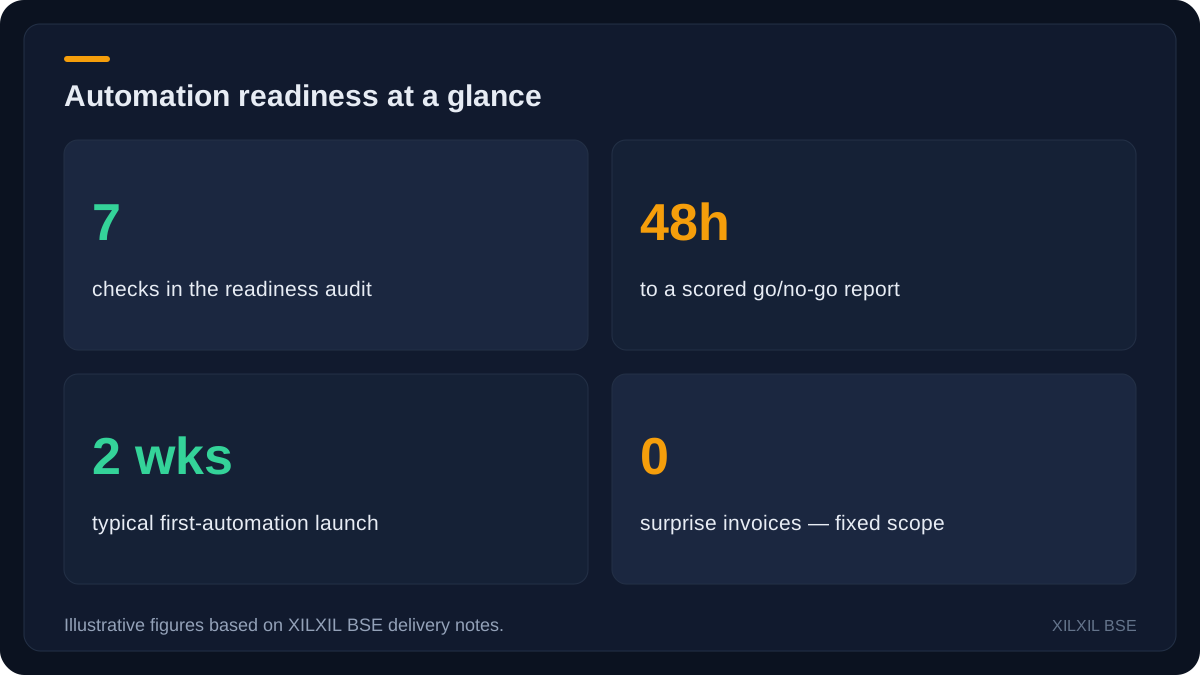
The panel below condenses automation readiness into the figures that actually move decisions — the same ones we put on client dashboards. Every value here is a clearly-labelled illustrative industry figure; the operative numbers for your business come from the baseline we instrument before any build starts (Measuring Automation ROI: The Metrics That Matter explains that discipline).
What readiness actually looks like in 2025
The companies that win with automation are rarely the ones with the biggest tool budget. They are the ones whose processes were already documented, measured and owned before a single workflow was drawn. Readiness is boring on purpose: one system of record per data type, one accountable owner per process, and a written definition of what “done” means.
Across our Dubai engagements we see the same pattern. Teams that score seven out of seven on the readiness checklist launch their first automation in under two weeks and keep it running for years. Teams that score three or below spend months rebuilding foundations mid-project — because every hidden spreadsheet dependency eventually becomes a midnight page.
The hidden cost of skipping the checklist
An unready automation does not fail loudly. It fails politely — duplicating a record here, skipping an edge case there — until someone notices that the numbers in the dashboard and the numbers in the bank account disagree. By then the automation has been running for months and trust in the whole programme is damaged.
That is why this checklist is sequenced the way it is: scope before data, data before economics, economics before tooling. Each step de-risks the next. You can run the full sequence in a single afternoon, and the output is a one-page brief that makes every future automation decision faster.
How XILXIL scores a process in 48 hours
Our readiness audit is a fixed-scope engagement: two working days, seven checks, one scored report with a go/no-go recommendation. We interview the process owner, sample the data quality, trace every hand-off, and price the automation honestly — including the unglamorous work of cleaning inputs.
The deliverable is deliberately short. If the answer is go, the report becomes the build brief. If the answer is not-yet, it lists exactly which checks failed and the fastest path to fixing them — often a two-week data cleanup instead of a full automation project.
A rollout that survives contact with reality
Resist the big-bang. The sequence that works for automation readiness: weeks one and two, run a small pilot on a single workflow with the old process still running alongside — the side-by-side comparison is the evidence that convinces everyone else. Weeks three and four, integrate with the surrounding systems and let the weekly review tune whatever the pilot exposed. From week six, scale to the rest of the team using the playbook the pilot produced.
Two guardrails keep the rollout honest. First, a named owner with the authority to change the process — automations without owners drift, and drift is how quiet failures start. Second, an explicit success metric agreed before the pilot begins, with the dashboard from Measuring Automation ROI: The Metrics That Matter keeping it visible from day one. With those two in place, scaling becomes a series of small, reversible decisions instead of one large bet.
The seven checks, condensed
Print this table, walk the process with its owner, and be honest about each row. A weak “yes” is a no.
| Check | Green means | Red flag |
|---|---|---|
| Scope on paper | Every step drawn, owner named | “It depends who is free” |
| Data quality | One system of record, predictable inputs | Three spreadsheets disagree |
| Economics | Repeated, rule-based, costly task | One-off creative judgement |
| Exceptions | Human override path documented | Exceptions live in someone’s head |
| Privacy | Data residency and consent mapped | “We just email it around” |
| Rollout | Pilot cohort and success metric agreed | Big-bang for the whole company |
| Review cadence | Monthly owner review scheduled | Nobody owns it after launch |
Score each row green, amber or red. Five greens or better: build. Below that: fix the reds first.
The data, visualised
Charts beat adjectives. The figures below are drawn from the illustrative dataset behind this article — treat the shapes as the lesson, and replace the placeholder values with your own baseline when the work starts.
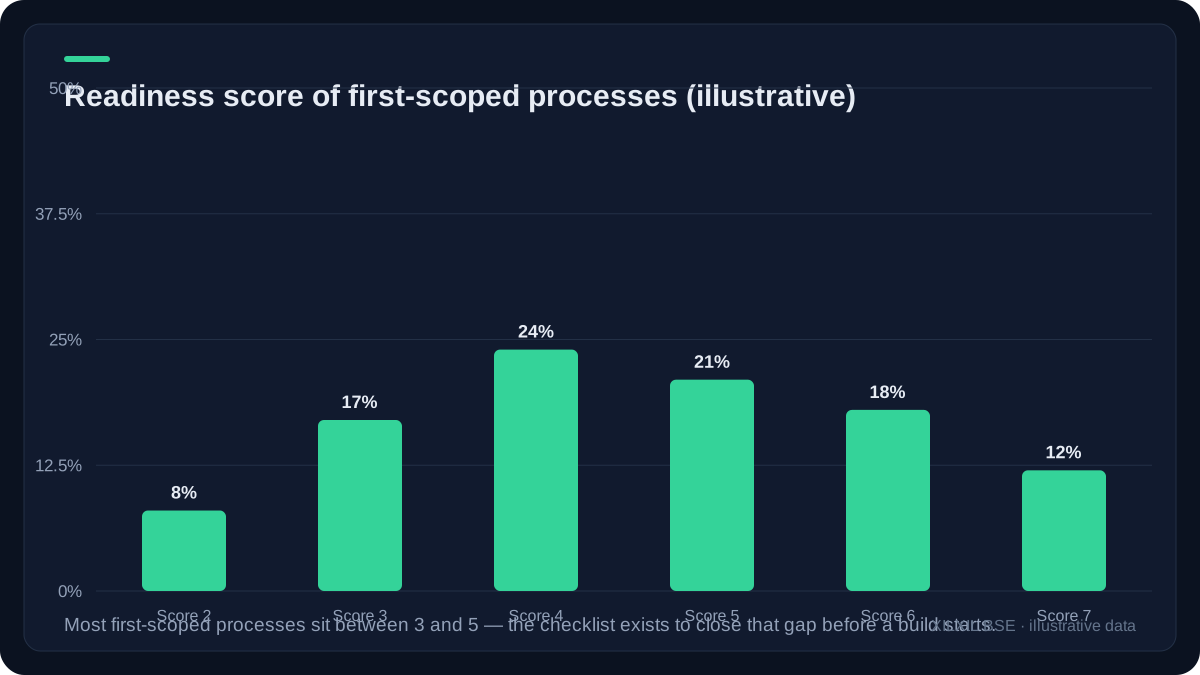

Automating a broken process does not fix the process — it just breaks faster, at scale, on schedule.
Key takeaways
- Map the process before you automate it — if you cannot draw it, you cannot automate it.
- Fix data sources first; automations amplify whatever they are fed.
- Confirm the economics: repeated, rule-based and costly tasks pay for themselves.
- Design the human override path before go-live, not after the first incident.
- Re-run the checklist every quarter — processes drift, and readiness drifts with them.
Frequently asked questions
How long does the readiness checklist take to run?
For a single process, one focused afternoon with the process owner. Our scored audit compresses it further: two working days end-to-end, ending in a go/no-go recommendation you can hand to finance.
Which check do most teams fail?
Data quality. Inputs arrive in unpredictable formats, and there is no single system of record. It is also the cheapest failure to fix — a two-week cleanup routinely saves a three-month rebuild.
Can we run the checklist ourselves?
Yes — that is the point of publishing it. The scored audit exists for teams who want an external, honest verdict before committing budget, or who are too close to the process to judge it coldly.
What happens after a green score?
The checklist output becomes the build brief: scope, data map, exceptions and rollout plan. From green score to first working automation, our median is two weeks.
Conclusion & next steps
That is the full picture: the context, the decisions, and the numbers behind automation readiness. If one sentence should survive this read, it is this — preparation compounds. Measure the baseline, make the process legible, then automate deliberately and review monthly; that sequence works for operations leads in the UAE and everywhere else.
Want a second pair of eyes on your checklist? Contact for a free review — and Pricing shows what a fixed-scope audit includes.
Picking tools for the job? Our honest, data-backed reviews live at Top AI Tools 2025 (SaaS & AI platforms) and Smart Home Picks (hardware worth the dirham) — illustrative benchmarks, clearly labelled, and never pay-to-play rankings.