
WhatsApp is where Dubai customers actually reply. An AI agent that answers in thirty seconds — in English or Arabic — converts enquiries that would otherwise cool off in the inbox. This playbook is the flow we deploy on client numbers.
The first sixty seconds
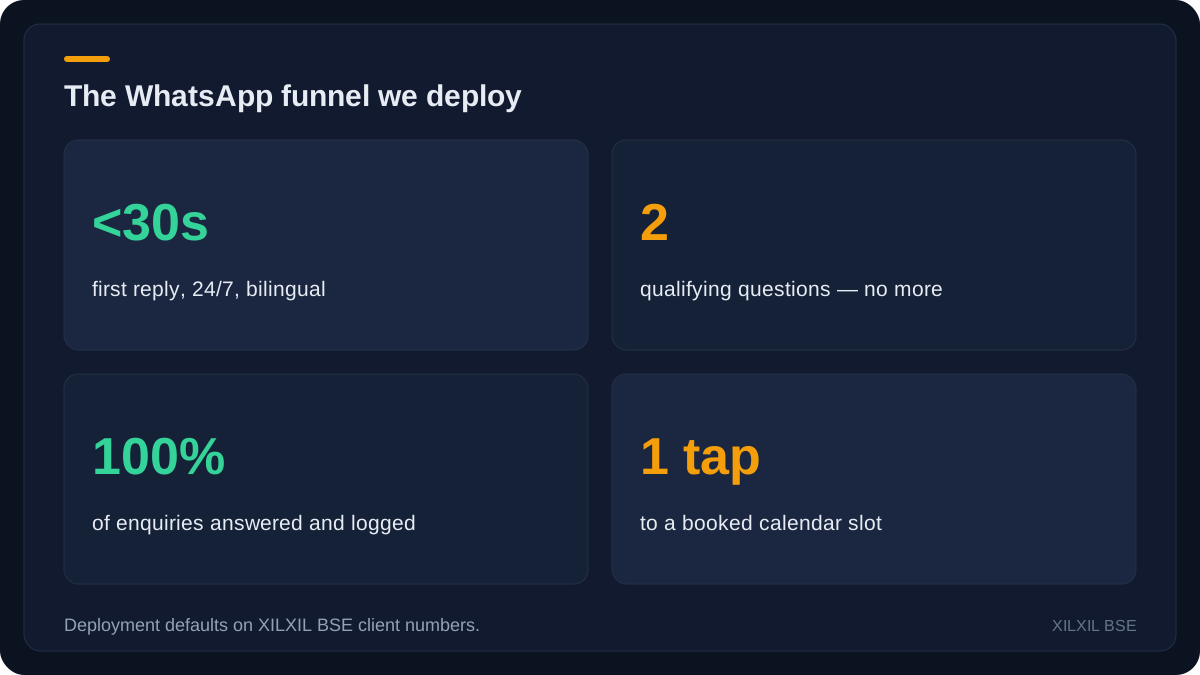
The agent greets, confirms intent and asks exactly two qualifying questions: what service, and when. Every extra question costs replies. Qualification is scored and routed — hot leads go straight to a human’s phone, the rest stay in a nurturing flow.
Booking without a human
The agent proposes two time slots from the calendar, confirms, and writes the booking into the CRM with source attribution. If the customer stalls, it follows up twice — politely — then hands the thread to a person with a full transcript.
- Reply in under 30 seconds, 24/7, bilingual
- Qualify with two questions, score and route
- Book into the calendar and log to the CRM
- Hand off with transcript when confidence drops
Measure it
Track reply time, qualification rate and booked jobs per hundred enquiries — the same metrics we use in Scaling Support Without Scaling Headcount: A 90-Day Plan. Ready to put an agent on your number? Contact and we will map the flow in a free discovery call.
The landscape in numbers
The panel below condenses WhatsApp AI agents into the figures that actually move decisions — the same ones we put on client dashboards. Every value here is a clearly-labelled illustrative industry figure; the operative numbers for your business come from the baseline we instrument before any build starts (Measuring Automation ROI: The Metrics That Matter explains that discipline).
Why WhatsApp beats every other channel in the Gulf
Email open rates in the UAE hover in the low twenties; WhatsApp message read rates sit above ninety percent. Your customers already live on WhatsApp — they use it to order food, chase deliveries and talk to their banks. Meeting them there is not an innovation play, it is basic availability.
The catch is speed. A lead answered in five minutes is dramatically more likely to convert than one answered the next morning. Human teams sleep, take Fridays off and get busy at month-end. A WhatsApp AI agent answers in thirty seconds, every time, in whichever language the customer opened with.
Designing the qualification flow
The best-performing flows we deploy share one trait: they are ruthlessly short. The agent confirms intent, asks two questions — what service, and when — and scores the reply. Every additional question measurably increases drop-off, so anything that can be inferred from the CRM is never asked aloud.
Scoring matters more than scripting. Hot leads (service matches, timeline inside two weeks) ring a human’s phone immediately. Warm leads enter a two-touch nurture sequence with genuinely useful content. Cold leads get a polite close and a catalogue link. Nothing is left to rot in an unread inbox.
Hand-off: where most agents embarrass themselves
Customers forgive an agent’s limitations; they do not forgive being trapped in a loop. The hand-off rule is absolute: when the agent’s confidence drops below threshold, or the customer’s sentiment turns negative, the full transcript is forwarded to a human with a one-line summary. The customer never has to repeat themselves.
We also instrument the boundary cases. Every hand-off is logged with its reason — low confidence, explicit request, sentiment trigger — and reviewed weekly. Those logs are where the next month’s script improvements come from; an agent that never hands off is usually lying about understanding.
A rollout that survives contact with reality
Resist the big-bang. The sequence that works for WhatsApp AI agents: weeks one and two, run a small pilot on a single workflow with the old process still running alongside — the side-by-side comparison is the evidence that convinces everyone else. Weeks three and four, integrate with the surrounding systems and let the weekly review tune whatever the pilot exposed. From week six, scale to the rest of the team using the playbook the pilot produced.
Two guardrails keep the rollout honest. First, a named owner with the authority to change the process — automations without owners drift, and drift is how quiet failures start. Second, an explicit success metric agreed before the pilot begins, with the dashboard from Measuring Automation ROI: The Metrics That Matter keeping it visible from day one. With those two in place, scaling becomes a series of small, reversible decisions instead of one large bet.
Agent vs human: who does what
The division of labour that keeps quality high and costs low. The agent owns volume; humans own judgement.
| Stage | AI agent | Human team |
|---|---|---|
| First reply | Instant, 24/7, bilingual | Escalation only |
| Qualification | Two questions, scored routing | Reviews hot-lead transcript |
| Booking | Proposes slots, writes to CRM | Complex/multi-day scheduling |
| Follow-up | Two polite automated touches | Personal close on hot leads |
| Hand-off | Full transcript + one-line summary | Takes over mid-thread, no repetition |
The data, visualised
Charts beat adjectives. The figures below are drawn from the illustrative dataset behind this article — treat the shapes as the lesson, and replace the placeholder values with your own baseline when the work starts.
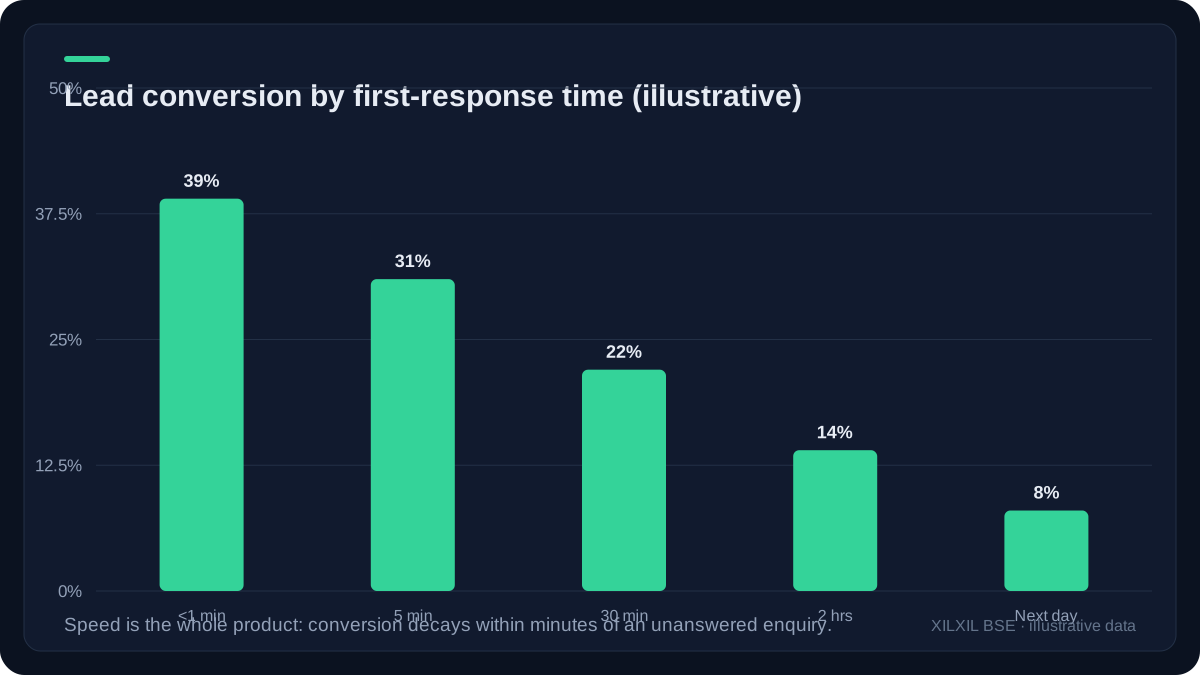

A lead answered in five minutes is worth more than ten leads answered tomorrow.
Key takeaways
- WhatsApp is the Gulf’s default business channel — availability there is table stakes.
- Reply in under thirty seconds; conversion decays within minutes otherwise.
- Qualify with two questions; every extra question costs replies.
- Score and route: hot leads ring a human, warm leads nurture, cold leads close politely.
- Hand off with a transcript — customers must never repeat themselves.
Frequently asked questions
Does the agent sound robotic?
The tone brief is yours: formal Arabic, friendly English, or a code-switching mix. Agents are reviewed against real transcripts weekly and tuned accordingly — the goal is a competent receptionist, not a gimmick.
What happens outside business hours?
That is the point of the agent: it books and qualifies around the clock, then hands your team a pre-qualified queue every morning instead of a wall of unanswered chats.
Which numbers can it run on?
The WhatsApp Business API works with your existing business number. Existing chat history stays intact; the agent simply joins the conversation layer.
How do you measure success?
Three numbers: median first-reply time, qualification rate, and booked jobs per hundred enquiries. The same dashboard is shared in Measuring Automation ROI: The Metrics That Matter.
Conclusion & next steps
That is the full picture: the context, the decisions, and the numbers behind WhatsApp AI agents. If one sentence should survive this read, it is this — preparation compounds. Measure the baseline, make the process legible, then automate deliberately and review monthly; that sequence works for service-business owners in Dubai and everywhere else.
Ready to put an agent on your number? Contact and we will map your flow in a free discovery call — Pricing shows the fixed-scope build.
Picking tools for the job? Our honest, data-backed reviews live at Top AI Tools 2025 (SaaS & AI platforms) and Smart Home Picks (hardware worth the dirham) — illustrative benchmarks, clearly labelled, and never pay-to-play rankings.



1 comment