

We ship client automations on all three platforms. The right answer depends on volume, sensitivity and who maintains the flows after hand-over — not on feature checklists.
Where each one wins
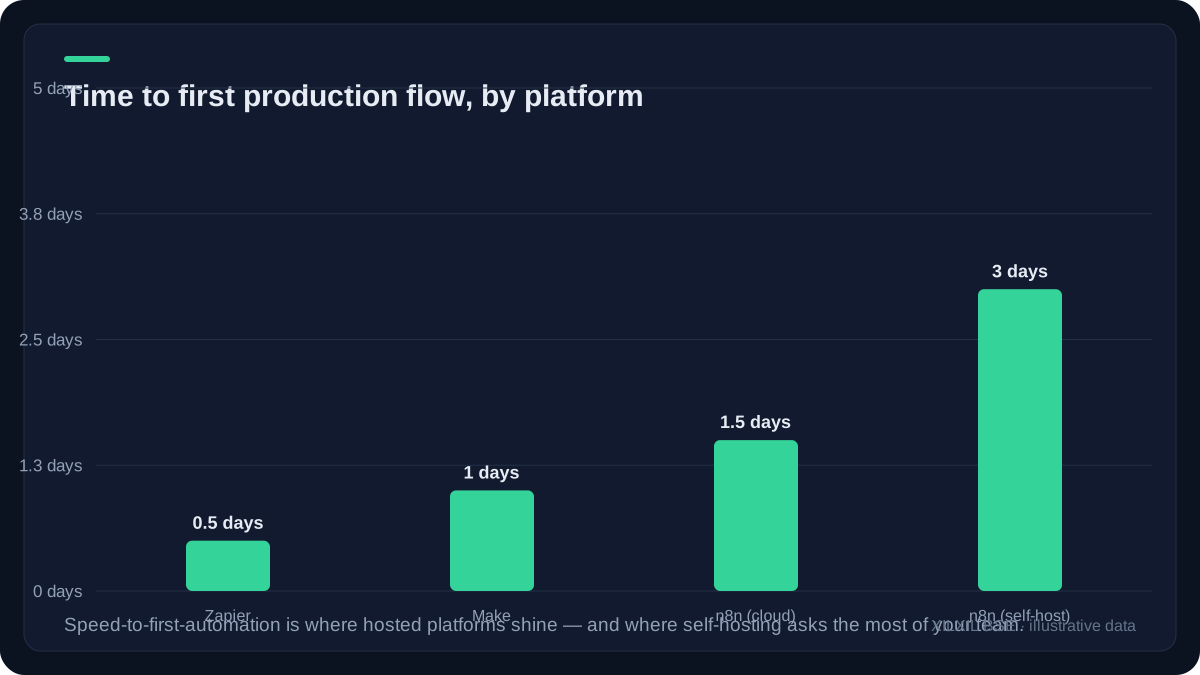
Zapier wins on time-to-first-automation: the connector catalogue is unmatched and non-engineers can maintain simple flows. Make wins on visual complexity per dirham — its scenario canvas handles branching elegantly. n8n wins on control: self-hosted, code-capable, unlimited executions.
The failure modes nobody demos
- Zapier: task pricing punishes success — high-volume flows get expensive fast
- Make: error handling is powerful but easy to under-build
- n8n: you own the uptime — patching and backups are your job
Our default for Dubai SMEs: n8n self-hosted for core operations (data stays in the UAE), Zapier for long-tail SaaS connectors. See the patterns we reuse in Inventory and Order Sync: The n8n Patterns We Reuse. For a fixed-scope recommendation, Pricing lists what a backbone migration includes.
The landscape in numbers
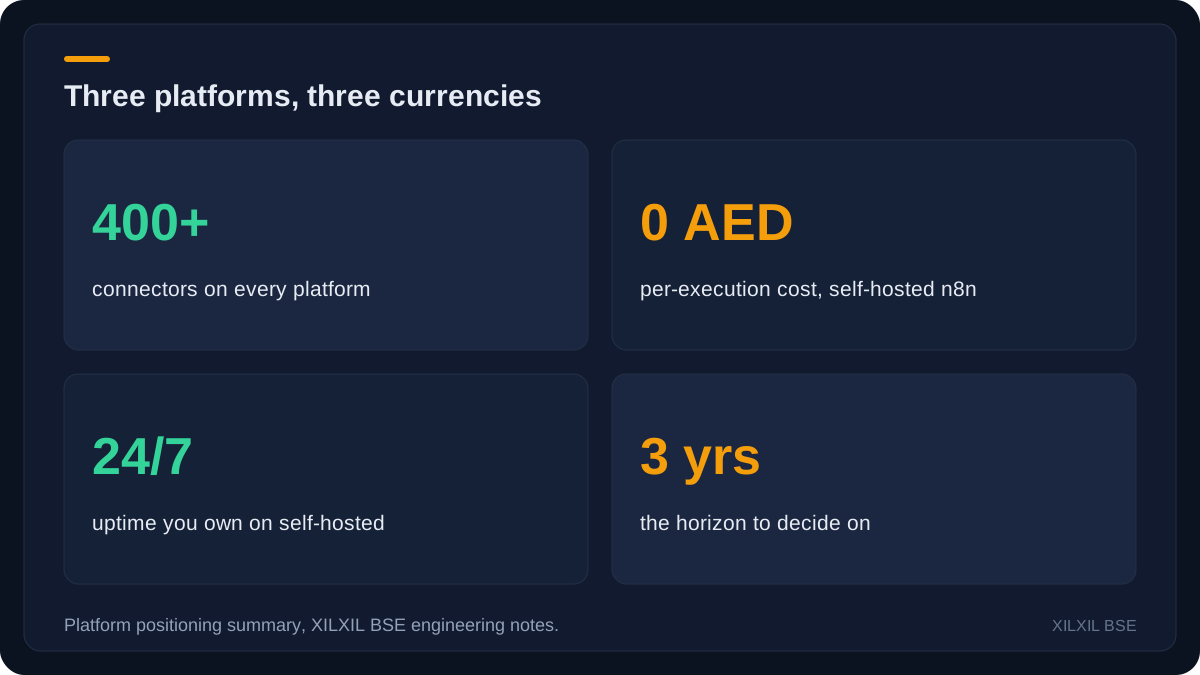
The panel below condenses automation platform selection into the figures that actually move decisions — the same ones we put on client dashboards. Every value here is a clearly-labelled illustrative industry figure; the operative numbers for your business come from the baseline we instrument before any build starts (Measuring Automation ROI: The Metrics That Matter explains that discipline).
Pricing models, decoded
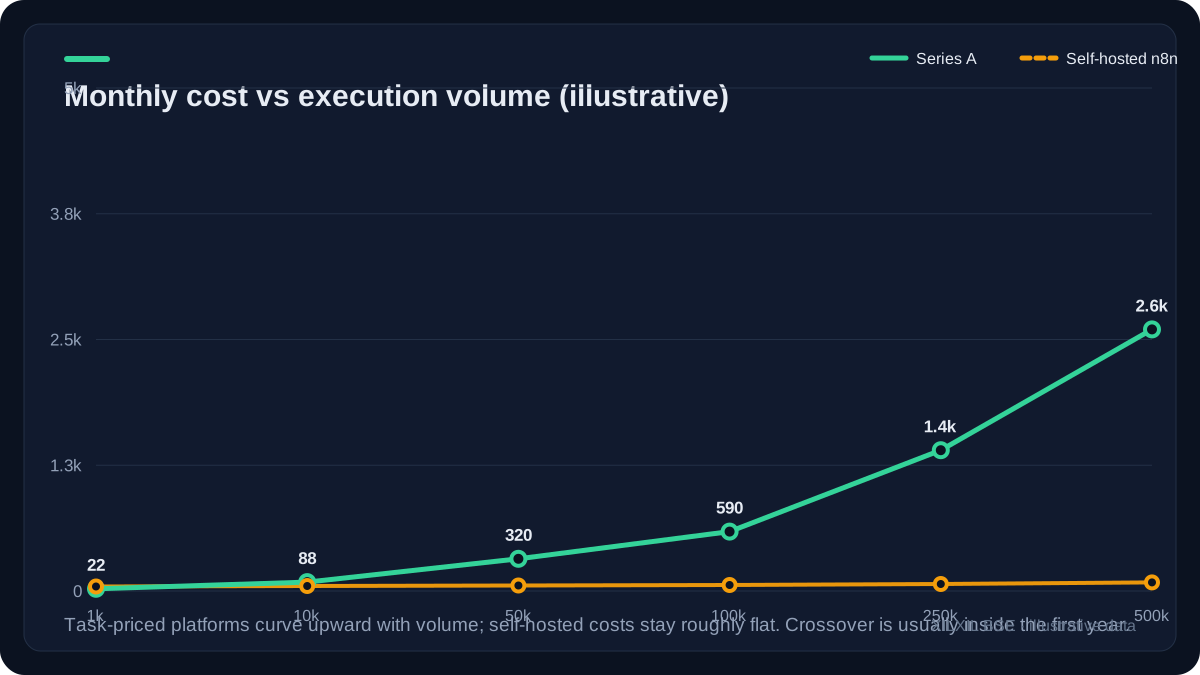
The three platforms bill for fundamentally different things, and that decides your bill more than any feature list. Zapier charges per task — every step in every run counts. Make charges per operation with cheaper unit rates but more granular counting. n8n, self-hosted, charges you nothing per execution: you pay for the server and the maintenance.
At one thousand executions a month the difference is trivia. At one hundred thousand it is the difference between a rounding error and a salary. Model your real volumes — including the retry storms — before you commit, and remember that successful automations get busier every quarter.
The failure modes nobody demos
Sales demos show happy paths. Production lives in the unhappy ones. Zapier’s task pricing punishes success: a retry storm on a high-volume flow can burn a month’s quota in an afternoon. Make’s error handlers are powerful but easy to under-build — scenarios fail silently until someone notices a missing report. n8n transfers operational ownership to you: patching, backups and uptime are your job, not your vendor’s.
None of these are disqualifiers; they are budgets of a different currency. Pay Zapier in money, Make in careful engineering, n8n in operations discipline. Choose the currency you actually have.
Our default stack for UAE SMEs
For most Dubai clients we default to self-hosted n8n for core operations — customer data never leaves infrastructure you control, which simplifies UAE data-residency conversations — paired with Zapier for the long tail of niche SaaS connectors n8n has not covered yet. The combination is boring, auditable and cheap at scale.
Migration between platforms is real work: authentication, data shapes and error handling all need porting. Pick with a three-year horizon, not a three-week one, and keep your most critical flows documented well enough to move if a vendor’s pricing changes under you.
A rollout that survives contact with reality
Resist the big-bang. The sequence that works for automation platform selection: weeks one and two, run a small pilot on a single workflow with the old process still running alongside — the side-by-side comparison is the evidence that convinces everyone else. Weeks three and four, integrate with the surrounding systems and let the weekly review tune whatever the pilot exposed. From week six, scale to the rest of the team using the playbook the pilot produced.
Two guardrails keep the rollout honest. First, a named owner with the authority to change the process — automations without owners drift, and drift is how quiet failures start. Second, an explicit success metric agreed before the pilot begins, with the dashboard from Measuring Automation ROI: The Metrics That Matter keeping it visible from day one. With those two in place, scaling becomes a series of small, reversible decisions instead of one large bet.
Decision matrix
Score each row for YOUR context — the right platform is contextual, not universal.
| Criterion | Zapier | Make | n8n self-hosted |
|---|---|---|---|
| Time to first automation | Best | Good | Moderate |
| Cost at 100k+ runs/mo | Highest | Medium | Lowest |
| Data residency control | Vendor cloud | Vendor cloud | Your infrastructure |
| Who maintains uptime | Vendor | Vendor | Your team |
| Custom code steps | Limited | Moderate | Full |
| Best fit | Long-tail SaaS glue | Visual branching logic | Core operations, volume |
The data, visualised
Charts beat adjectives. The figures below are drawn from the illustrative dataset behind this article — treat the shapes as the lesson, and replace the placeholder values with your own baseline when the work starts.
Pay Zapier in money, Make in careful engineering, n8n in operations discipline — pick the currency you have.
Key takeaways
- Pricing models, not feature lists, decide your long-term bill.
- Model real volumes including retry storms before committing.
- Zapier = speed and connectors; Make = visual branching; n8n = control and cost at scale.
- Self-hosting transfers uptime ownership to you — budget the operations discipline.
- The pragmatic UAE default: self-hosted n8n for core ops, Zapier for the long tail.
Frequently asked questions
Can we start on Zapier and migrate to n8n later?
Yes, and it is a common path — start hosted while volumes are low, migrate the high-volume flows when the maths flips. Keep flows documented and data shapes clean and the port is days, not months.
Is self-hosted n8n hard to run?
It is one Docker container and a database, but production-grade means backups, updates and monitoring. If nobody on your team wants that job, the hosted tiers or a managed deployment are the honest choice.
Which is best for AI agent workflows?
All three call LLM APIs well. The differentiators are loop control and error handling — n8n’s code nodes make agentic retry logic easiest to express and audit.
How does this compare with the tools on your Top Picks page?
Top AI Tools 2025 benchmarks the SaaS layer we most often connect these platforms to — the backbone choice and the SaaS choice are separate decisions.
Conclusion & next steps
That is the full picture: the context, the decisions, and the numbers behind automation platform selection. If one sentence should survive this read, it is this — preparation compounds. Measure the baseline, make the process legible, then automate deliberately and review monthly; that sequence works for technical decision-makers in the UAE and everywhere else.
Want a fixed-scope recommendation for your volumes? Pricing lists what a backbone audit includes — or Contact and bring your execution counts.
Picking tools for the job? Our honest, data-backed reviews live at Top AI Tools 2025 (SaaS & AI platforms) and Smart Home Picks (hardware worth the dirham) — illustrative benchmarks, clearly labelled, and never pay-to-play rankings.



1 comment