

The best prompts in a company rarely come from engineers — they come from the people who know the process. Operations teams can write production-grade prompts with a five-part pattern and zero code.
The five-part pattern
- Role: who the AI is — ‘you are our booking assistant’
- Context: the facts it may use, and where they come from
- Examples: one good answer, one bad answer
- Format: exactly what the output looks like
- Boundary: what it must refuse, and when to hand off
Prompts are processes
A prompt that touches customers is a process document — it needs an owner, a review date and a test set, exactly like the flows in When NOT to Automate: Human-in-the-Loop by Design. Grounding matters too: prompts that answer from your documents should sit on RAG, covered in RAG in Plain English: Grounding AI in Your Business Data.
We train operations teams to write and maintain their own prompts — it ships inside every agent build. Book a training session via Contact.
The landscape in numbers
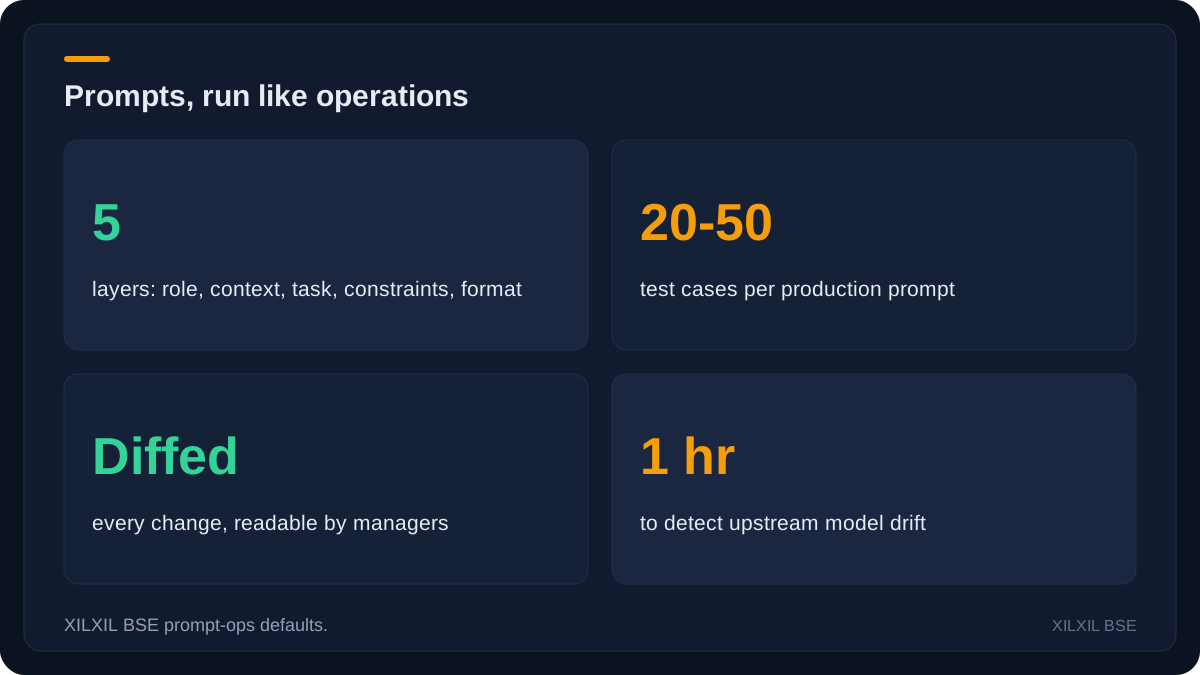
The panel below condenses prompt engineering into the figures that actually move decisions — the same ones we put on client dashboards. Every value here is a clearly-labelled illustrative industry figure; the operative numbers for your business come from the baseline we instrument before any build starts (Measuring Automation ROI: The Metrics That Matter explains that discipline).
Prompts are operations artefacts, not magic words
In business workflows, a prompt is a specification with a runtime: it has inputs it depends on, outputs it must produce, failure modes it must avoid, and a version history you can audit. Teams that treat prompts as art produce demos that never survive Monday; teams that treat them as artefacts ship systems that hold up.
The operational turn is simple: every production prompt lives in version control, carries a test set, and changes through review like any other code. The person who “writes good prompts” is not a wizard — they are the engineer who documents intent and measures outputs.
The five-layer prompt structure we standardise
Role and goal: who the model is and what success means. Context: exactly the data it needs, nothing more. Task: the transformation, stated as a specification. Constraints: what it must never do — invent, leak, editorialise. Format: the output shape, machine-checkable. Each layer is testable, which is what makes the whole thing maintainable.
The constraints layer deserves the most care — it is where business rules live. “Cite sources or abstain”, “never quote a price not in the context”, “answer in the customer’s language”: these are policy, expressed as prompts, and they change through the same review process as any policy.
Evaluation without data-science theatre
A production prompt needs a test set of twenty to fifty real cases: the happy paths, the traps, the ambiguous ones. Changes run against the set before deployment; the diff is readable by a manager, not just an engineer. When a model version changes upstream, the same set tells you within an hour whether anything drifted.
The honest metric is not “creativity” — it is pass rate on the test set plus a human review queue for the borderline cases. Two weeks of that loop produces prompts that hold their quality at 2am, in Arabic, on a support ticket nobody anticipated.
A rollout that survives contact with reality
Resist the big-bang. The sequence that works for prompt engineering: weeks one and two, run a small pilot on a single workflow with the old process still running alongside — the side-by-side comparison is the evidence that convinces everyone else. Weeks three and four, integrate with the surrounding systems and let the weekly review tune whatever the pilot exposed. From week six, scale to the rest of the team using the playbook the pilot produced.
Two guardrails keep the rollout honest. First, a named owner with the authority to change the process — automations without owners drift, and drift is how quiet failures start. Second, an explicit success metric agreed before the pilot begins, with the dashboard from Measuring Automation ROI: The Metrics That Matter keeping it visible from day one. With those two in place, scaling becomes a series of small, reversible decisions instead of one large bet.
The five layers, with examples
Copy the structure; the content is your business policy.
| Layer | Contains | Example line |
|---|---|---|
| Role & goal | Identity + success definition | “You are a support agent; success is a resolved ticket” |
| Context | Minimal necessary data | “Here are the customer’s last 3 orders” |
| Task | The transformation, specified | “Classify into one of 6 categories” |
| Constraints | Policy as prohibitions | “Never quote prices absent from context” |
| Format | Machine-checkable output | “Reply as JSON: category, confidence” |
The data, visualised
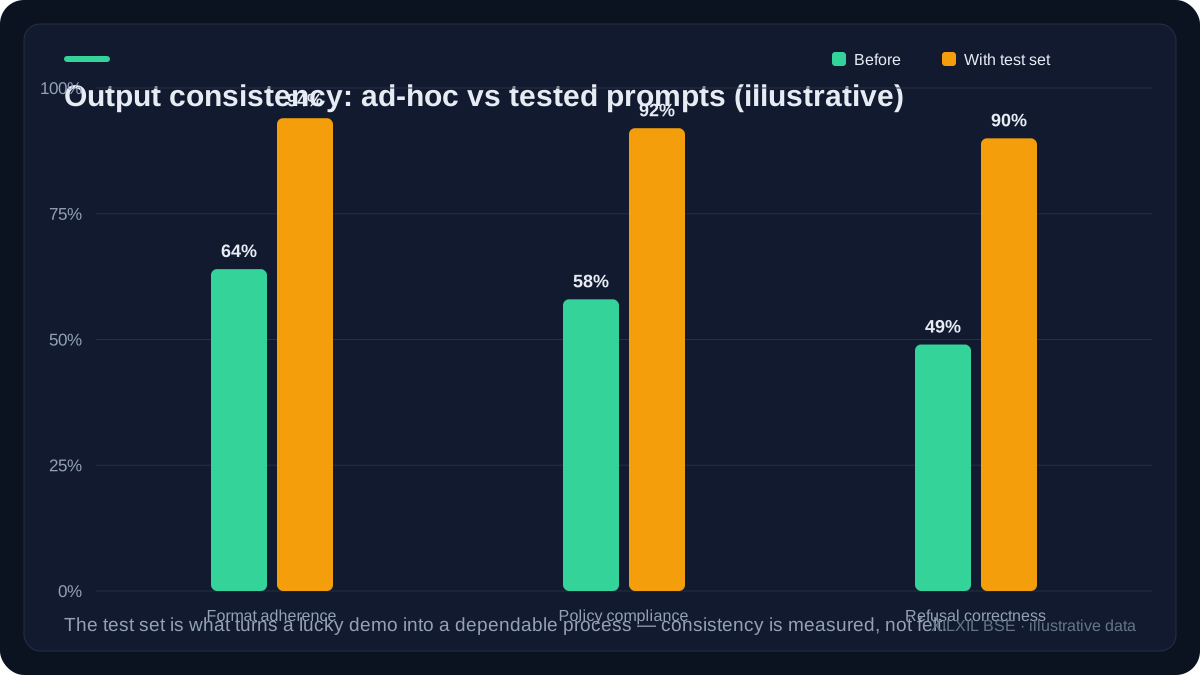
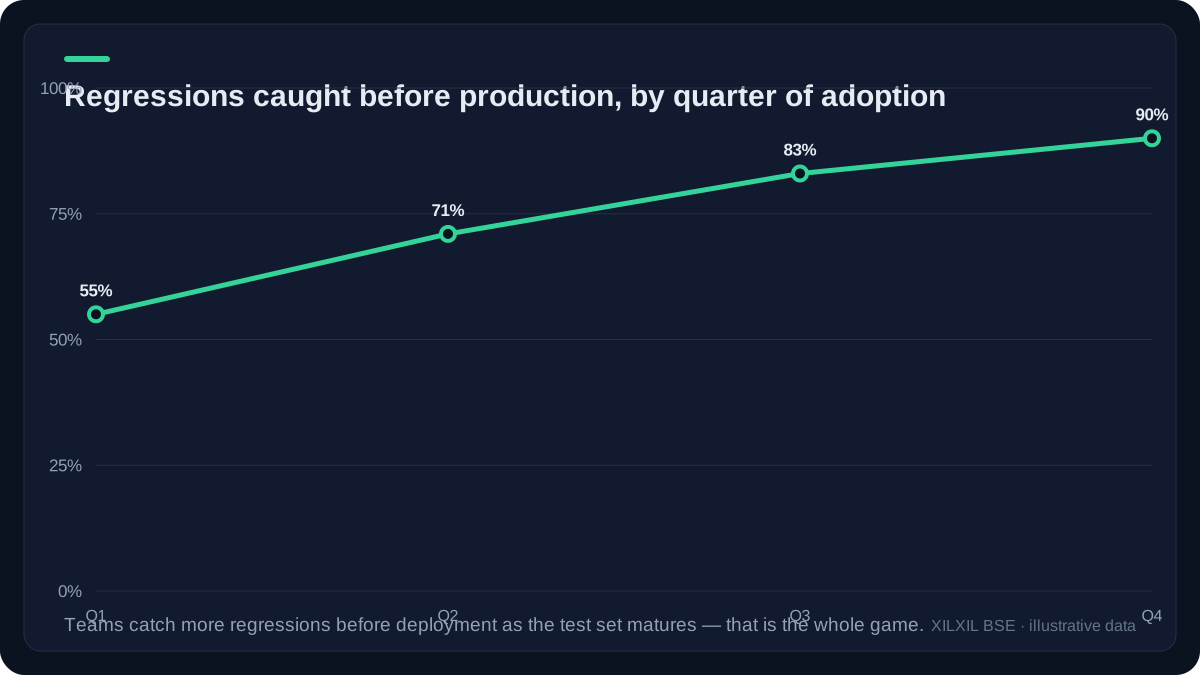
Charts beat adjectives. The figures below are drawn from the illustrative dataset behind this article — treat the shapes as the lesson, and replace the placeholder values with your own baseline when the work starts.
The person who writes good prompts is not a wizard — they are the engineer who documents intent and measures outputs.
Key takeaways
- Treat prompts as specifications with runtimes — versioned, tested, reviewed.
- Five layers: role, context, task, constraints, format — each testable.
- Constraints are business policy expressed as prompt; change them through review.
- A 20-50 case test set catches regressions and upstream model drift.
- Consistency is measured on a pass rate, never judged by feel.
Frequently asked questions
Do we need a prompt engineer on staff?
You need the discipline, not the job title. One engineer owning the structure plus a manager reviewing policy constraints covers most SME operations.
How often do prompts need updating?
When policy, product or model changes — the test set tells you which. Prompts that change weekly are a sign the task specification is unstable, not that prompting is hard.
Can the same structure work for Arabic outputs?
Yes — the five layers are language-agnostic; the test set gains Arabic cases and the format layer checks bidi rendering. The discipline transfers unchanged.
How does this connect to our agents?
Every agent at Demo Projects runs prompts managed this way — it is the difference between a demo and a deployment. Contact to see the loop.
Conclusion & next steps
That is the full picture: the context, the decisions, and the numbers behind prompt engineering. If one sentence should survive this read, it is this — preparation compounds. Measure the baseline, make the process legible, then automate deliberately and review monthly; that sequence works for operations or product leads in your workflows and everywhere else.
Prompts in production deserve this discipline. Contact to audit your current prompts against the five layers — takes a day.
Picking tools for the job? Our honest, data-backed reviews live at Top AI Tools 2025 (SaaS & AI platforms) and Smart Home Picks (hardware worth the dirham) — illustrative benchmarks, clearly labelled, and never pay-to-play rankings.


1 comment