Commerce automations fail in predictable ways: rate limits, half-written orders, webhooks that fire twice. After enough builds, the same four n8n patterns emerge — and we now reuse them on every project.
The four patterns
- Idempotent writes: every sync carries a deduplication key
- Queue, don’t chain: a lightweight queue absorbs API rate limits
- Reconcile nightly: a full-count job catches what webhooks missed
- Alert on drift: stock mismatch beyond a threshold pages a human
Why self-hosted wins here
High-volume syncs on task-priced platforms get expensive and fragile — the economics from n8n vs Zapier vs Make: Choosing Your Automation Backbone. Self-hosted n8n gives unlimited runs and retry control, with the drift alerts landing in the same channel as Invoice-to-Cash: Automating Accounts Receivable Step by Step.
We ship commerce sync as a fixed-scope build with the monitoring included. Bring your stack to Contact and we will map the flows in one call.
The landscape in numbers
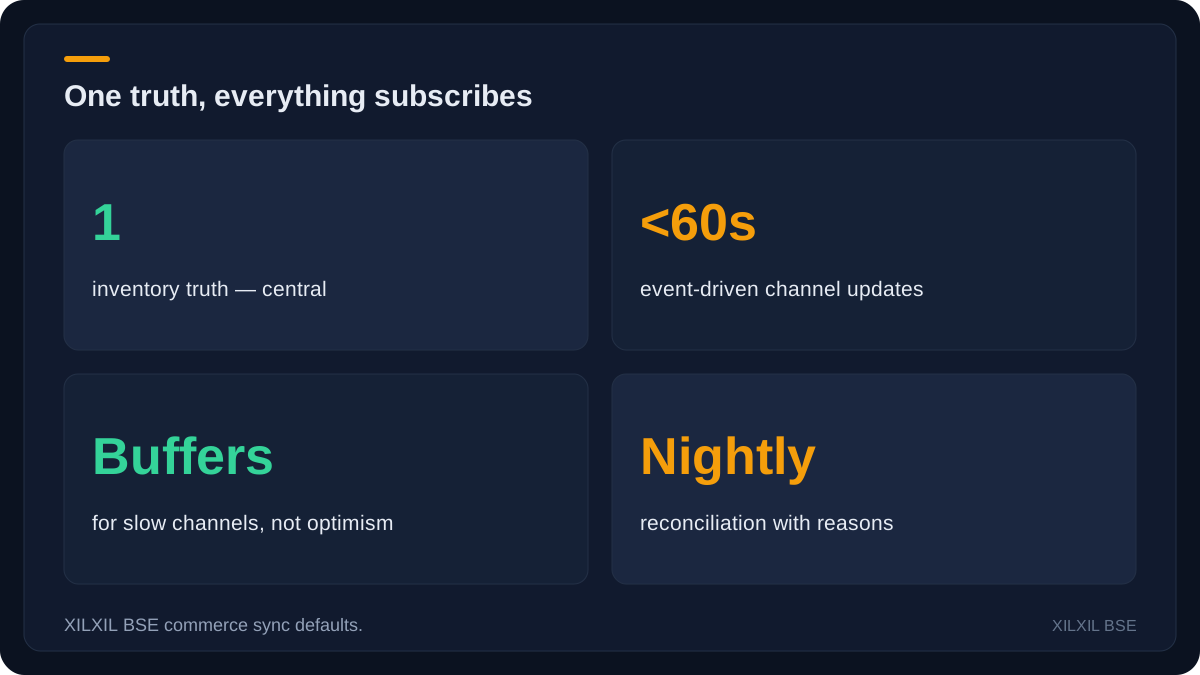
The panel below condenses inventory and order sync into the figures that actually move decisions — the same ones we put on client dashboards. Every value here is a clearly-labelled illustrative industry figure; the operative numbers for your business come from the baseline we instrument before any build starts (Measuring Automation ROI: The Metrics That Matter explains that discipline).
The oversell problem is an architecture problem
Every multichannel seller knows the 9pm message: the item sold on three channels simultaneously and two customers must be refunded. The instinct is to blame a channel or a plugin; the reality is architectural — inventory was treated as a value to copy around instead of a truth to subscribe to.
The patterns that end oversells share one idea: one inventory truth, everything else subscribes. Central availability lives in one system; channels receive updates within seconds; every sale decrements the truth before the order confirmation leaves. Slow channels get safety buffers rather than blind optimism.
Sync patterns, weakest to strongest
Scheduled polling — every fifteen minutes, each channel is asked for changes — is the entry pattern: simple, cheap, and forgiving of small drift, but it guarantees oversell windows during any sale. Event-driven sync reacts to each order and stock movement as it happens, which closes the window to seconds. Reserve-and-confirm adds a reservation layer for checkout, releasing on timeout.
The right pattern is economic, not technical: polling costs almost nothing and suits slow-moving catalogues; event-driven sync costs more to build and pays for itself the first time a promotion would have oversold. High-velocity SKUs justify reservation flows even when nothing else needs them.
Reconciliation: the safety net that makes it trustworthy
Every sync architecture drifts eventually — a channel API has a bad hour, a refund arrives as two records. The nightly reconciliation job compares channel stock against the truth, reports variances with reasons, and auto-corrects the trivial ones. The morning report is one page: variances found, causes, and whether anyone needs to act.
That report is what makes the system trustworthy enough to turn off the manual checks. Teams stop re-counting stock at midnight not because they were told to trust the sync, but because the reconciliation report has earned that trust publicly, night after night.
A rollout that survives contact with reality
Resist the big-bang. The sequence that works for inventory and order sync: weeks one and two, run a small pilot on a single workflow with the old process still running alongside — the side-by-side comparison is the evidence that convinces everyone else. Weeks three and four, integrate with the surrounding systems and let the weekly review tune whatever the pilot exposed. From week six, scale to the rest of the team using the playbook the pilot produced.
Two guardrails keep the rollout honest. First, a named owner with the authority to change the process — automations without owners drift, and drift is how quiet failures start. Second, an explicit success metric agreed before the pilot begins, with the dashboard from Measuring Automation ROI: The Metrics That Matter keeping it visible from day one. With those two in place, scaling becomes a series of small, reversible decisions instead of one large bet.
Choosing your sync pattern
Match the pattern to SKU velocity — over-engineering slow SKUs is its own waste.
| Catalogue profile | Recommended pattern | Why |
|---|---|---|
| Slow movers, few channels | Scheduled polling (15 min) | Cheap, adequate, simple |
| Mixed velocity, promotions | Event-driven sync | Closes the oversell window |
| High-velocity SKUs | Event-driven + reservations | Checkout-safe under load |
| Marketplace-heavy | Event-driven + buffers | Platform lag needs margins |
The data, visualised
Charts beat adjectives. The figures below are drawn from the illustrative dataset behind this article — treat the shapes as the lesson, and replace the placeholder values with your own baseline when the work starts.
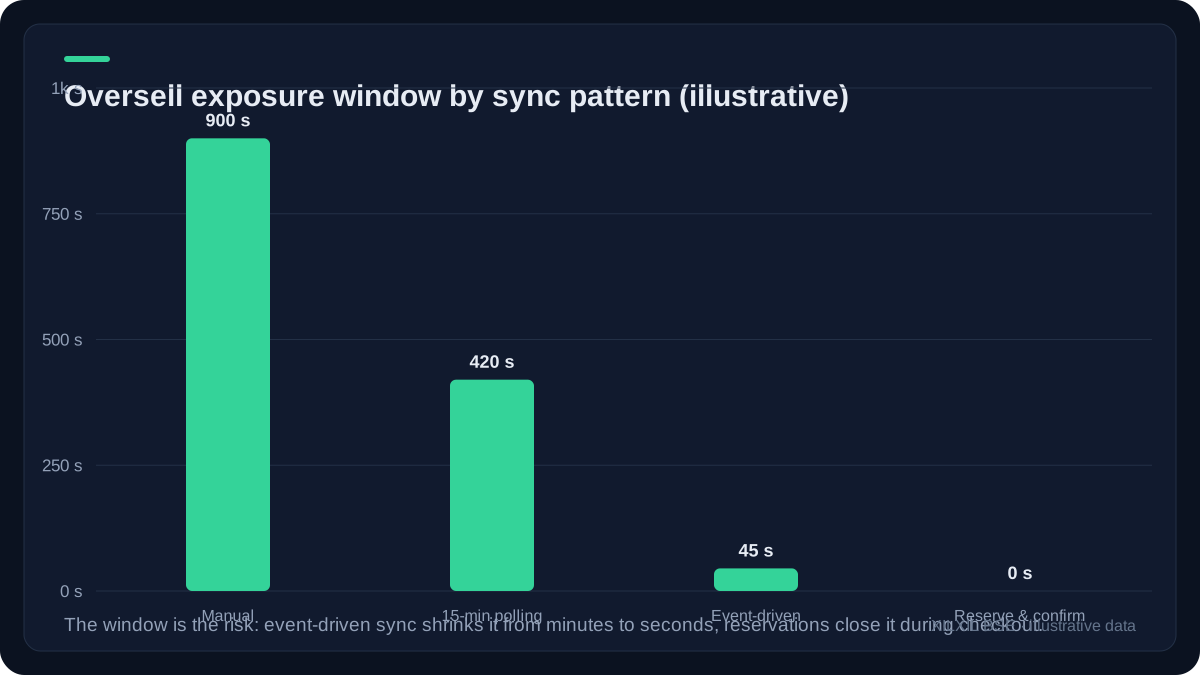

Inventory is not a value to copy around — it is a truth to subscribe to.
Key takeaways
- One inventory truth; channels subscribe rather than hold copies.
- Polling suits slow catalogues; promotions and fast SKUs need event-driven sync.
- Reserve-and-confirm protects checkout for high-velocity items.
- Safety buffers for slow channels beat optimistic availability every time.
- Nightly reconciliation with reasons is what earns the right to switch off manual checks.
Frequently asked questions
Which platforms do you sync?
Shopify, WooCommerce, Amazon.ae, Noon and common POS systems — the pattern is platform-agnostic; the connectors are the per-project detail.
What happens when a channel API goes down?
The channel is flagged, its buffer widens automatically, and the reconciliation report shows exactly what happened when it returns. Degrade honestly instead of guessing.
Can we start with polling and upgrade later?
Yes — the truth layer and reconciliation are built the same way either time; upgrading the sync pattern later is a connector change, not a rebuild.
How is ROI measured here?
Oversell incidents per month (before/after), channel-availability accuracy, and the recovered hours of manual re-counting — Measuring Automation ROI: The Metrics That Matter explains the dashboard.
Conclusion & next steps
That is the full picture: the context, the decisions, and the numbers behind inventory and order sync. If one sentence should survive this read, it is this — preparation compounds. Measure the baseline, make the process legible, then automate deliberately and review monthly; that sequence works for e-commerce operations leads in your channels and everywhere else.
Selling on more than two channels? Contact for a free sync architecture sketch — Pricing lists the fixed-scope build.