Most chatbots are English products with Arabic bolted on. Dubai customers notice immediately. An Arabic-first agent is designed right-to-left from the start — and switches languages mid-conversation without missing a beat.
Design decisions that matter
- RTL layouts for Arabic, LTR for English — same conversation thread
- Dialect awareness: Gulf phrasing over textbook Modern Standard where it suits
- Mid-sentence switching: customers mix languages constantly
- Formal vs informal register matched to the industry
Testing with real phrasing
Test scripts written by native speakers, not translated strings. Numbers, dates and addresses formatted per locale. The voice side has its own rules — AI Voice Agents for Dubai SMEs: Scripts That Actually Convert covers pronunciation and code-switching on calls.
Bilingual delivery is built into every engagement we ship — it is one of our four promises, and it is priced in, not an add-on. See Pricing or start at Contact.
The landscape in numbers
The panel below condenses Arabic-first chatbots into the figures that actually move decisions — the same ones we put on client dashboards. Every value here is a clearly-labelled illustrative industry figure; the operative numbers for your business come from the baseline we instrument before any build starts (Measuring Automation ROI: The Metrics That Matter explains that discipline).
“Arabic supported” is not Arabic-first
Most Arabic chatbot experiences in the wild are English bots with a translation layer — and customers feel the difference instantly. Word order is wrong, formality is off, and the bot cannot parse Gulf dialect written in Latin script (“abghi a7ejz”, the way people actually type). An Arabic-first agent is designed in Arabic: intents, tone, formality registers and RTL layout from day one.
The payoff is measurable. First-contact resolution on Arabic-first deployments consistently beats the translated equivalent, because the bot understands the question as asked — including the code-switching that defines real Gulf conversations, where a sentence starts in Arabic and ends with an English product name.
Dialect, formality and the politeness layer
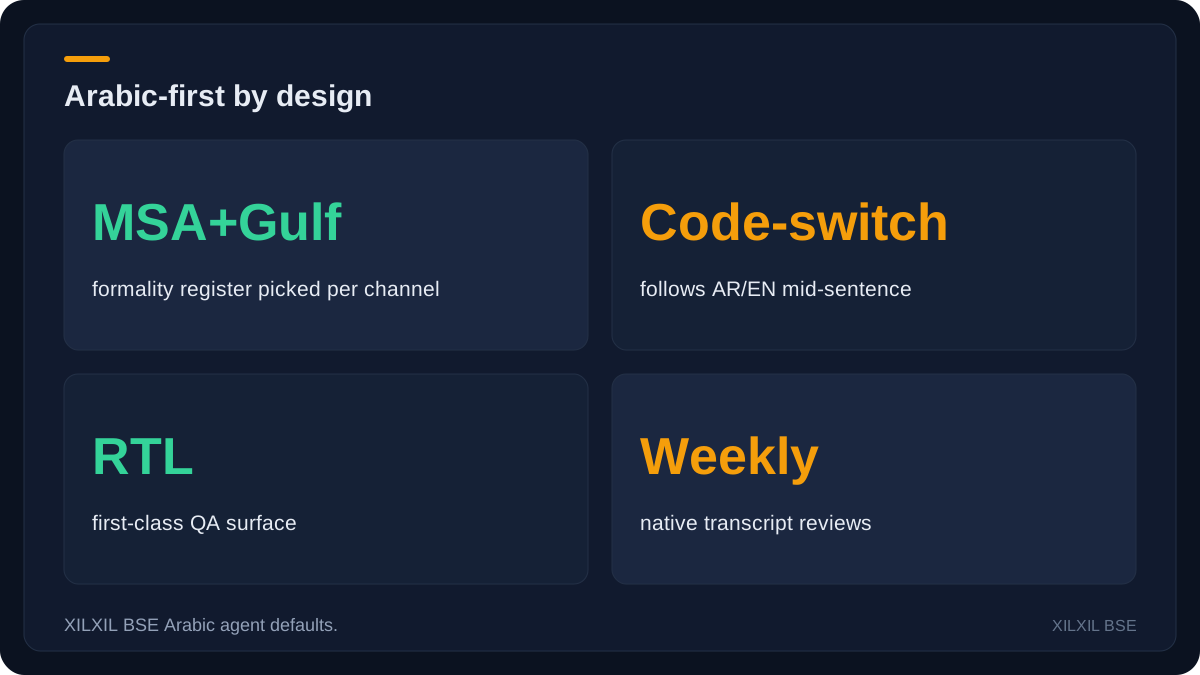
Arabic is not one register. A government customer expects formal MSA; a retail shopper on Instagram writes Gulf dialect with emoji. The politeness layer is a design component: it picks register by channel and context, uses the correct gender forms, and knows when the customer has switched languages — and follows them within the same sentence.
This is where cheap deployments collapse. Mis-gendered forms or a stiff MSA reply to a casual dialect message read as disrespect, not as technology. The fix is a reviewed response bank plus generation constraints — and weekly transcript reviews with a native reviewer, permanently, not just at launch.
RTL is a product surface
Right-to-left is not a CSS flag. Dates, amounts, mixed-direction product names, screenshot layouts, share cards — each has a correct bidi treatment, and getting them wrong produces messages that are technically Arabic and practically unreadable. Arabic-first means the RTL render is a first-class test surface with its own QA pass.
The same rigour applies to the admin side: transcripts, analytics and the response editor must handle RTL too, or your Arabic-speaking agents work in a degraded tool — and quality quietly decays.
A rollout that survives contact with reality
Resist the big-bang. The sequence that works for Arabic-first chatbots: weeks one and two, run a small pilot on a single workflow with the old process still running alongside — the side-by-side comparison is the evidence that convinces everyone else. Weeks three and four, integrate with the surrounding systems and let the weekly review tune whatever the pilot exposed. From week six, scale to the rest of the team using the playbook the pilot produced.
Two guardrails keep the rollout honest. First, a named owner with the authority to change the process — automations without owners drift, and drift is how quiet failures start. Second, an explicit success metric agreed before the pilot begins, with the dashboard from Measuring Automation ROI: The Metrics That Matter keeping it visible from day one. With those two in place, scaling becomes a series of small, reversible decisions instead of one large bet.
Arabic-first checklist
Use this to audit any vendor’s “Arabic support” claim in ten minutes.
| Layer | Ask the vendor | Arabic-first answer |
|---|---|---|
| Intents | Designed in Arabic? | Yes — not translated from English |
| Dialect | Parses Gulf dialect + Arabizi? | Yes, with code-switching |
| Politeness | Register per channel/context? | Yes, with gender-correct forms |
| RTL | RTL QA pass defined? | Yes — product surface, not a flag |
| Reviews | Native transcript reviews? | Weekly, permanent |
The data, visualised
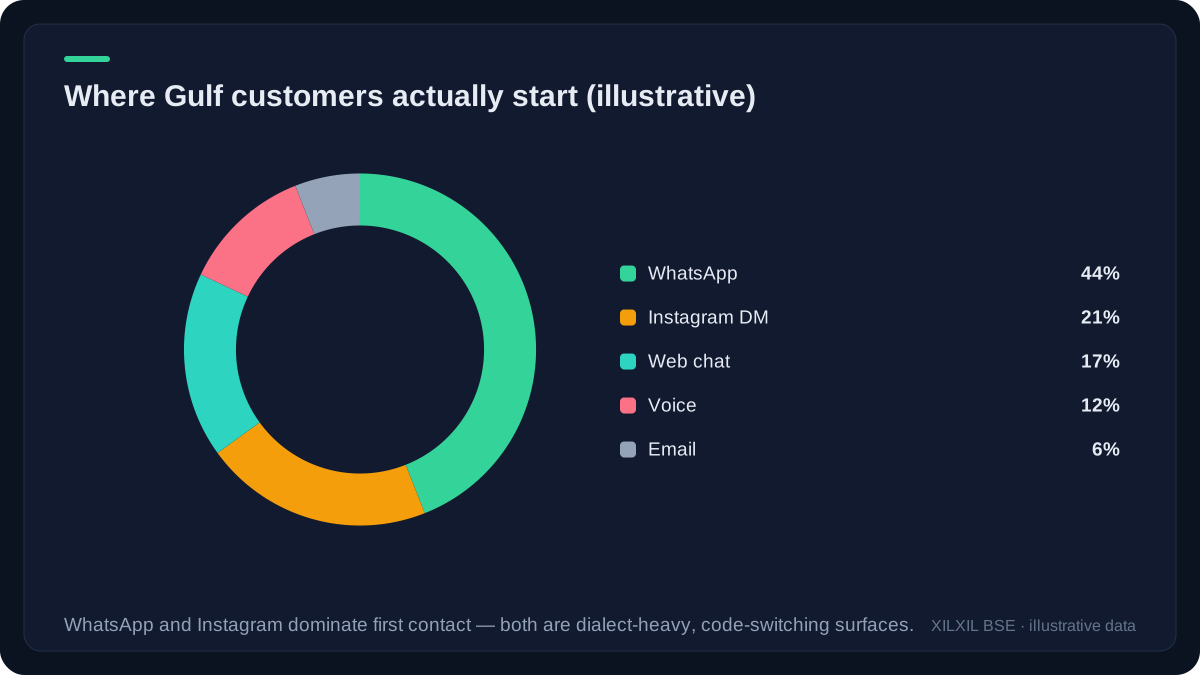
Charts beat adjectives. The figures below are drawn from the illustrative dataset behind this article — treat the shapes as the lesson, and replace the placeholder values with your own baseline when the work starts.

A mis-gendered form reads as disrespect, not technology. Politeness is a design component.
Key takeaways
- Design in Arabic; translated English bots never feel native.
- Support Gulf dialect, Arabizi and mid-sentence code-switching — that is how people type.
- Formality registers are chosen per channel and context, with correct gender forms.
- RTL is a first-class QA surface across customer-facing AND admin screens.
- Weekly native transcript reviews keep quality from decaying after launch.
Frequently asked questions
Which Arabic variants are covered?
Modern Standard Arabic plus Gulf dialect patterns, with vocabulary tuning per market. Egyptian and Levantine variants can be layered for regional teams.
Can the bot switch languages mid-conversation?
Yes — mid-sentence code-switching is supported and expected. Many Gulf conversations start in Arabic and finish with an English product name; the agent follows naturally.
How long does tuning take?
Launch in three to four weeks; register and vocabulary tuning is weekly thereafter with a native reviewer, which is what keeps resolution climbing.
Does the dashboard handle RTL?
Yes — transcripts, analytics and the response editor are all RTL-tested. Your Arabic-speaking agents get a first-class tool, not a translated afterthought.
Conclusion & next steps
That is the full picture: the context, the decisions, and the numbers behind Arabic-first chatbots. If one sentence should survive this read, it is this — preparation compounds. Measure the baseline, make the process legible, then automate deliberately and review monthly; that sequence works for customer-experience leads in the Gulf and everywhere else.
Test us in Arabic: Contact and we will demo an agent answering your real FAQs, dialect included — Demo Projects has live examples.
Picking tools for the job? Our honest, data-backed reviews live at Top AI Tools 2025 (SaaS & AI platforms) and Smart Home Picks (hardware worth the dirham) — illustrative benchmarks, clearly labelled, and never pay-to-play rankings.