Your customers now search in three places: the classic Google results page, AI assistants that recommend businesses directly, and answer engines that cite sources. Ranking in one no longer means ranking in the others.
The three surfaces
- SEO: keywords, technical health, backlinks — still the foundation
- GEO: being the business AI assistants name when asked for a category
- AEO: being the source answer engines quote with a link
What actually moves GEO and AEO
Structured, factual content that machines can verify: clear service pages, consistent business data, real case notes with numbers — the format Measuring Automation ROI: The Metrics That Matter uses. Reviews that mention specifics. Schema markup that says what the page is in machine language.
We run SEO/GEO/AEO programs as fixed-scope monthly engagements — the honest kind, with weekly deliverables. Baselines and reporting live in Pricing; a free audit starts at Contact.
The landscape in numbers
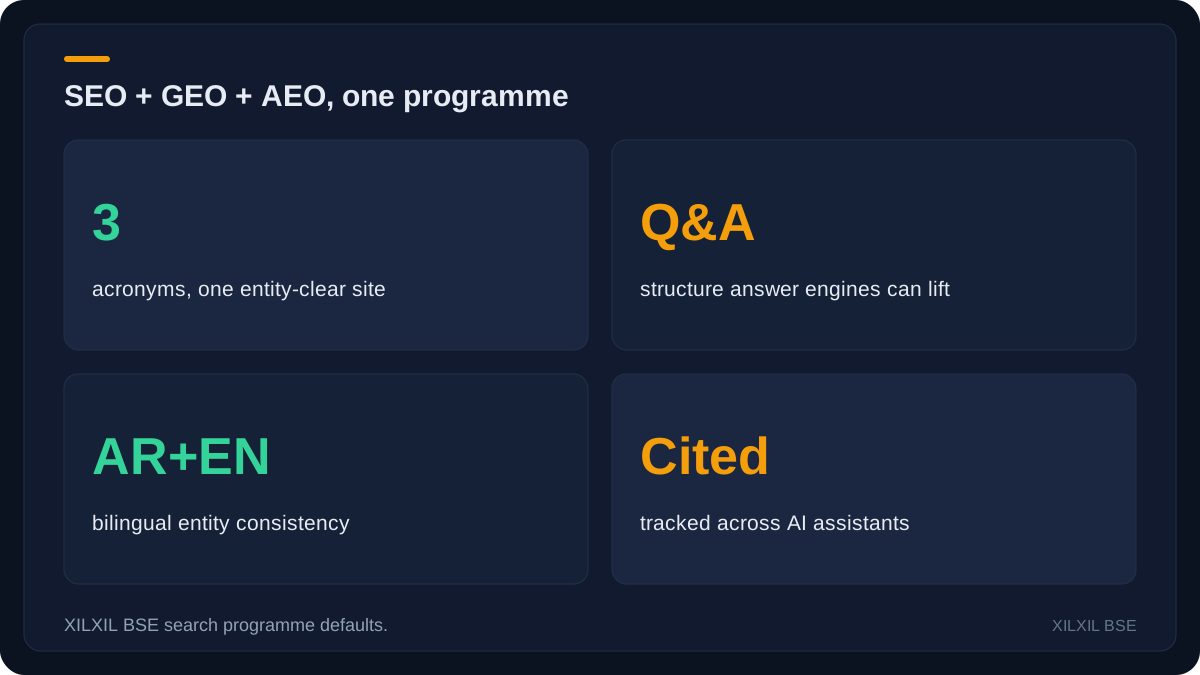
The panel below condenses SEO, GEO and AEO into the figures that actually move decisions — the same ones we put on client dashboards. Every value here is a clearly-labelled illustrative industry figure; the operative numbers for your business come from the baseline we instrument before any build starts (Measuring Automation ROI: The Metrics That Matter explains that discipline).
Three acronyms, one discipline
SEO is ranking in the classic search results. GEO (generative engine optimisation) is being cited inside AI-generated answers — ChatGPT, Gemini, Perplexity. AEO (answer engine optimisation) is owning the direct answers, featured snippets and voice responses that skip the ten blue links entirely. They reward overlapping but not identical qualities.
The overlap is entity clarity: a site that says plainly who it is, what it does, where it operates, and proves it with structured data, consistent facts and cited specifics — that site is legible to crawlers, answer engines and language models alike. Vagueness is the only strategy all three punish.
What GEO actually changes in the work
Classic SEO taught us to write for queries. GEO writing targets questions and entities: short definitional passages an answer engine can lift, statistics with sources, author credentials, and FAQ blocks that match the way people actually ask. Structure matters as much as prose — headings that are questions, answers that are paragraphs, tables that compare.
Measurement changes too. Beyond rankings and clicks, track citation share: how often your brand or content appears in AI answers for your category queries. It is a new, imperfect metric — and the only one that reflects the traffic pattern reshaping search behaviour right now.
The UAE angle
Arabic-first content is the widest open arbitrage in Gulf search: competition is thinner, and both Google and the AI assistants are hungry for well-structured Arabic sources. Bilingual entity consistency — the same company facts in Arabic and English, marked up identically — compounds the advantage.
Local specifics matter to answer engines: licensing language, free-zone versus mainland distinctions, VAT treatment, emirate-level service areas. Content that names those specifics earns the citation; generic global copy does not.
A rollout that survives contact with reality
Resist the big-bang. The sequence that works for SEO, GEO and AEO: weeks one and two, run a small pilot on a single workflow with the old process still running alongside — the side-by-side comparison is the evidence that convinces everyone else. Weeks three and four, integrate with the surrounding systems and let the weekly review tune whatever the pilot exposed. From week six, scale to the rest of the team using the playbook the pilot produced.
Two guardrails keep the rollout honest. First, a named owner with the authority to change the process — automations without owners drift, and drift is how quiet failures start. Second, an explicit success metric agreed before the pilot begins, with the dashboard from Measuring Automation ROI: The Metrics That Matter keeping it visible from day one. With those two in place, scaling becomes a series of small, reversible decisions instead of one large bet.
The three optimisations at a glance
Same site, three audiences, one foundation of entity clarity.
| Optimises for | Primary surface | Core tactic |
|---|---|---|
| SEO | Classic rankings | Intent-matched pages, technical health, links |
| GEO | AI-generated answers | Citable passages, statistics, entity markup |
| AEO | Snippets & voice answers | Question headings, direct answers, FAQ schema |
All three inherit the same base: fast pages, consistent facts, structured data.
The data, visualised
Charts beat adjectives. The figures below are drawn from the illustrative dataset behind this article — treat the shapes as the lesson, and replace the placeholder values with your own baseline when the work starts.
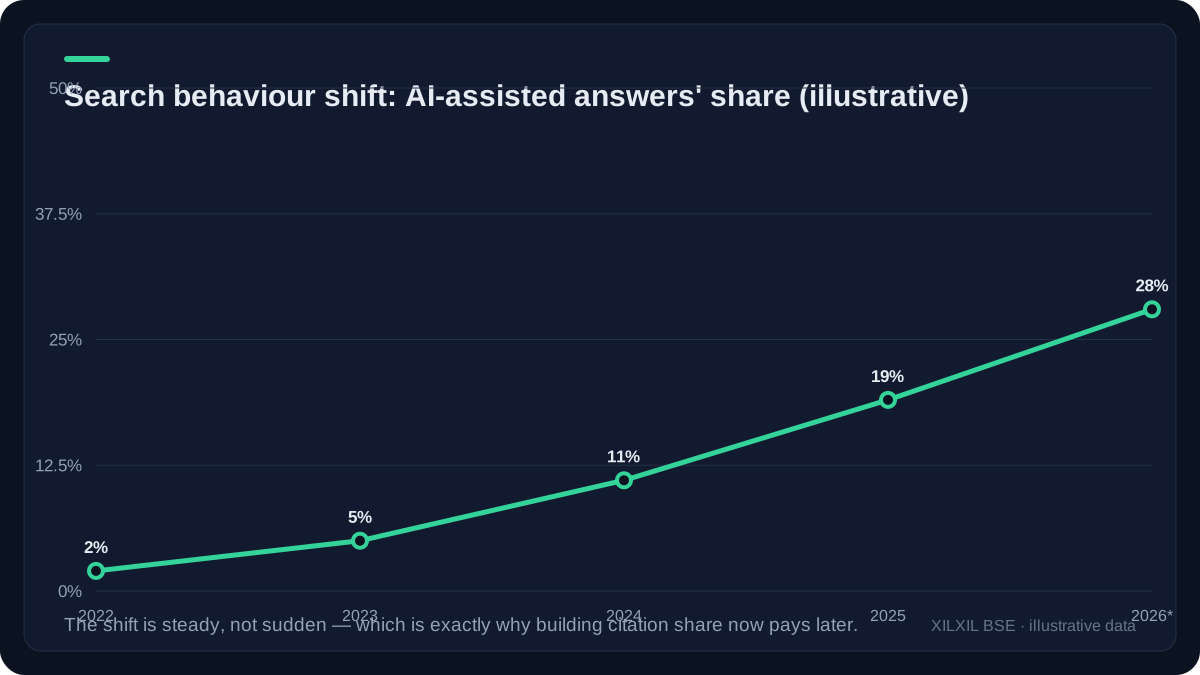
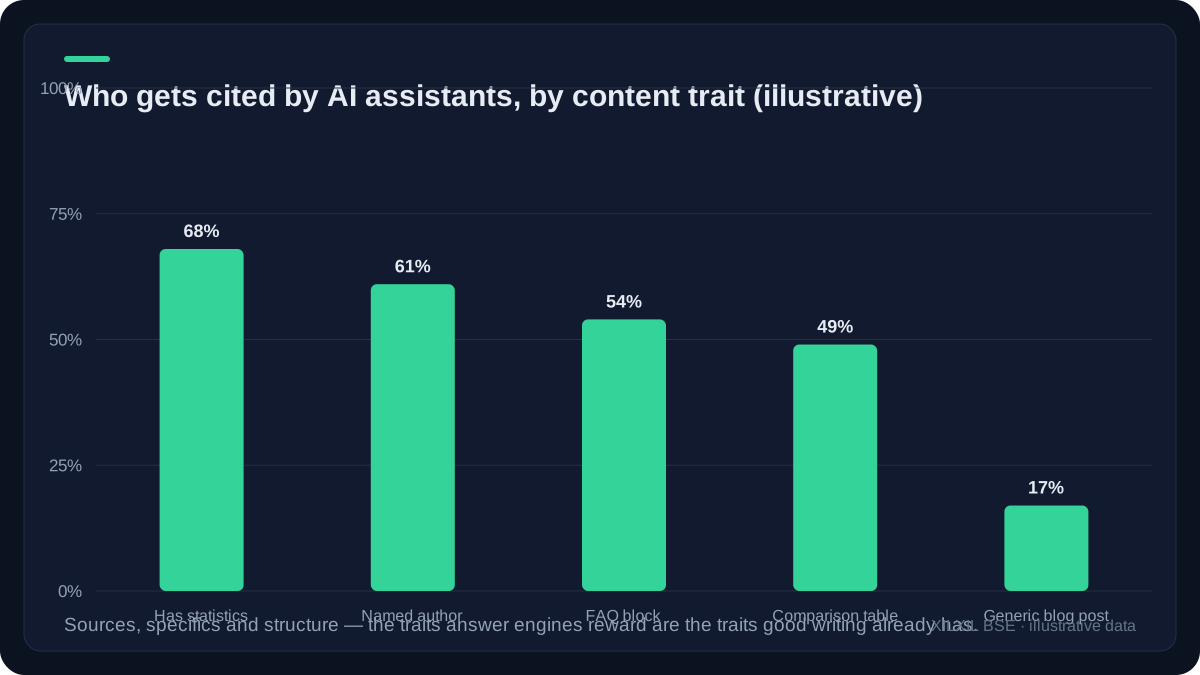
Vagueness is the only strategy all three engines punish. Entity clarity wins everywhere at once.
Key takeaways
- SEO, GEO and AEO reward the same foundation: entity clarity with proof.
- Write lift-able passages: question headings, direct answers, sourced statistics.
- Track citation share across AI assistants — the metric that reflects where search is going.
- Arabic-first content is the Gulf’s widest open search arbitrage.
- Local specifics (licensing, VAT, free-zone) are what earn the citation.
Frequently asked questions
Do we need different pages for AI answers?
No — the same well-structured pages serve all three. Where you add value is in the passages and schema that make existing pages lift-able, not in a shadow site for bots.
How do you measure GEO results?
A monthly citation audit across the major assistants for your category queries — where you are cited, with what wording, and which competitor took the answer you wanted.
Is blogging still worth it?
More than ever — but as citable reference material, not keyword filler. Every post on this blog follows the structure this article describes, for exactly that reason.
What is the first deliverable?
A fixed-scope audit: technical health, entity consistency AR/EN, and a citation baseline. Pricing lists it — Contact books it.
Conclusion & next steps
That is the full picture: the context, the decisions, and the numbers behind SEO, GEO and AEO. If one sentence should survive this read, it is this — preparation compounds. Measure the baseline, make the process legible, then automate deliberately and review monthly; that sequence works for marketing leads in the UAE and everywhere else.
Want to know if AI assistants recommend you today? Contact for the citation baseline — it is eye-opening either way.
Picking tools for the job? Our honest, data-backed reviews live at Top AI Tools 2025 (SaaS & AI platforms) and Smart Home Picks (hardware worth the dirham) — illustrative benchmarks, clearly labelled, and never pay-to-play rankings.