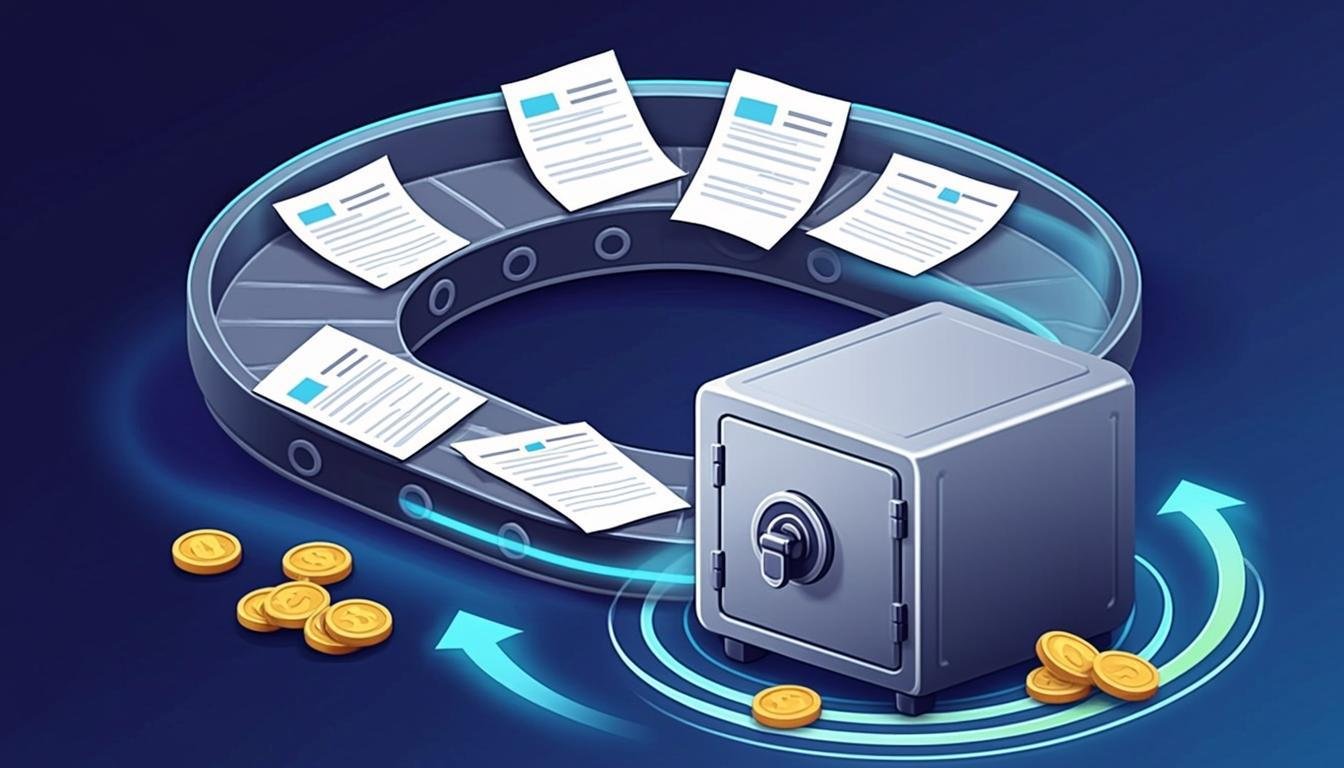
Cash flow dies in the gap between sending an invoice and banking the money. Automating accounts receivable is the fastest cash injection most SMEs can build — no new customers required.
The loop, end to end
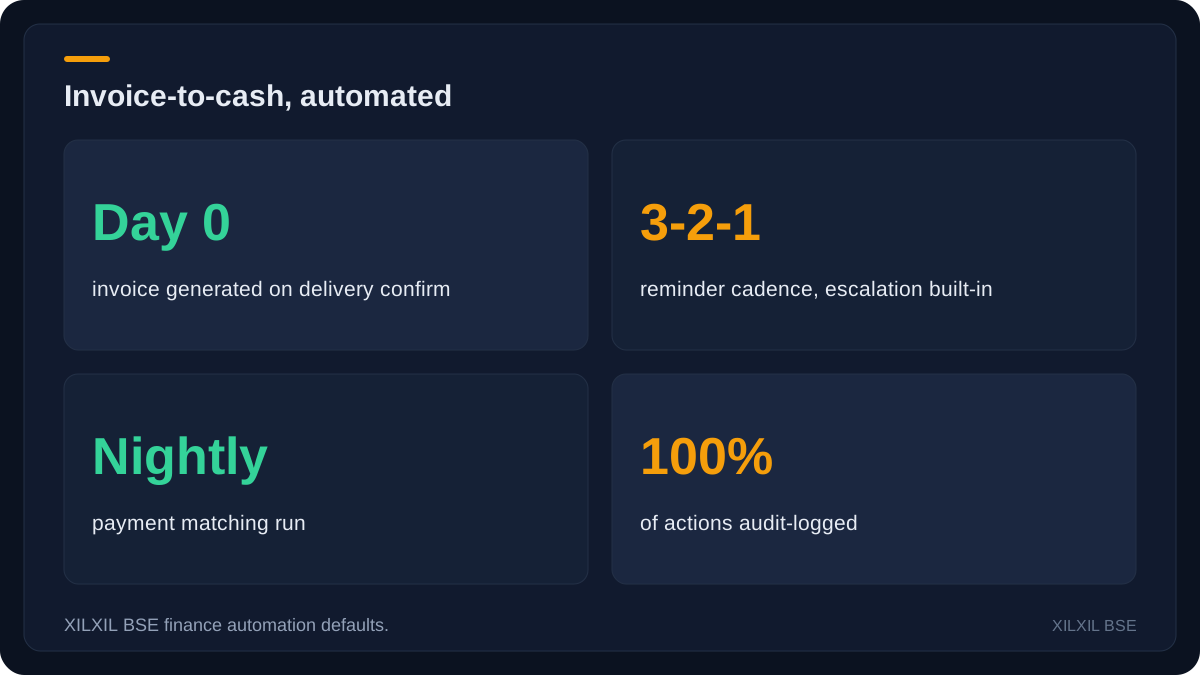
- Generate the invoice from the CRM record — zero re-typing
- Deliver by email and WhatsApp with a payment link
- Reminder ladder: polite at 3 days, firmer at 14, human at 30
- Reconcile payments nightly and flag short-pays
- Weekly AR ageing summary to the owner’s phone
Where humans stay in the loop
Disputes and partial payments deserve judgement — the automation flags, the human decides. That boundary is the theme of When NOT to Automate: Human-in-the-Loop by Design. The receipt side pairs with the sync patterns in Inventory and Order Sync: The n8n Patterns We Reuse.
Typical result: days-sales-outstanding drops by a third in one quarter. Scope yours with Contact — fixed price, agreed before build.
The landscape in numbers
The panel below condenses invoice-to-cash into the figures that actually move decisions — the same ones we put on client dashboards. Every value here is a clearly-labelled illustrative industry figure; the operative numbers for your business come from the baseline we instrument before any build starts (Measuring Automation ROI: The Metrics That Matter explains that discipline).
Where the days actually hide
Days sales outstanding is not one number; it is a queue of small waits. Two days while the invoice waits for approval, three while it sits unsent because a purchase order is missing, five while a customer “processes it next run”, ten more before anyone chases politely. None of these waits is dramatic — that is exactly why they survive.
Automating the queue is unglamorous and enormously effective. Invoice generation triggers on delivery confirmation, not on someone remembering. Missing-PO detection blocks the send before it happens, not after. Reminder cadences fire on schedule with escalation that matches the customer’s actual payment behaviour, not a generic template.
Matching payments without the spreadsheet
Cash application is where automation pays for itself fastest in UAE businesses: remittance emails in three formats, bank statements in two currencies, and a part-payment that covers two invoices and half of another. Rules plus an extraction model match the bulk; the remainder queue is small enough for a human to clear in minutes.
The payoff is a receivables position you can actually read. When matching runs nightly, the “who owes us what” question has an answer at 9am — and the dunning list, the promised-payment tracker and the provision calculation all read from the same matched truth.
Controls that keep finance comfortable
Automation in finance must be auditable or it will not be adopted. Every automated action carries an immutable log entry: what triggered it, what rule fired, what was sent to whom. Thresholds keep humans in the loop where exposure is real — credit notes, write-offs and anything above a limit you set.
We deploy with a shadow period first: the automation proposes actions, finance approves in one click, and after two clean weeks the approvals flip to exceptions-only. Trust is earned by the log, not requested by the vendor.
A rollout that survives contact with reality
Resist the big-bang. The sequence that works for invoice-to-cash: weeks one and two, run a small pilot on a single workflow with the old process still running alongside — the side-by-side comparison is the evidence that convinces everyone else. Weeks three and four, integrate with the surrounding systems and let the weekly review tune whatever the pilot exposed. From week six, scale to the rest of the team using the playbook the pilot produced.
Two guardrails keep the rollout honest. First, a named owner with the authority to change the process — automations without owners drift, and drift is how quiet failures start. Second, an explicit success metric agreed before the pilot begins, with the dashboard from Measuring Automation ROI: The Metrics That Matter keeping it visible from day one. With those two in place, scaling becomes a series of small, reversible decisions instead of one large bet.
The invoice-to-cash chain, before and after
Every row is a wait that used to be invisible — and is now measured, then removed.
| Stage | Before | After automation |
|---|---|---|
| Invoice generation | Manual, batched Fridays | Triggered on delivery confirmation |
| PO check | Discovered after bounce | Blocked before send |
| Reminders | Generic template, ad-hoc | Cadenced, behaviour-matched escalation |
| Payment matching | Spreadsheet archaeology | Nightly rules + extraction, small exception queue |
| Reporting | Month-end reconstruction | Live receivables position |
The data, visualised
Charts beat adjectives. The figures below are drawn from the illustrative dataset behind this article — treat the shapes as the lesson, and replace the placeholder values with your own baseline when the work starts.
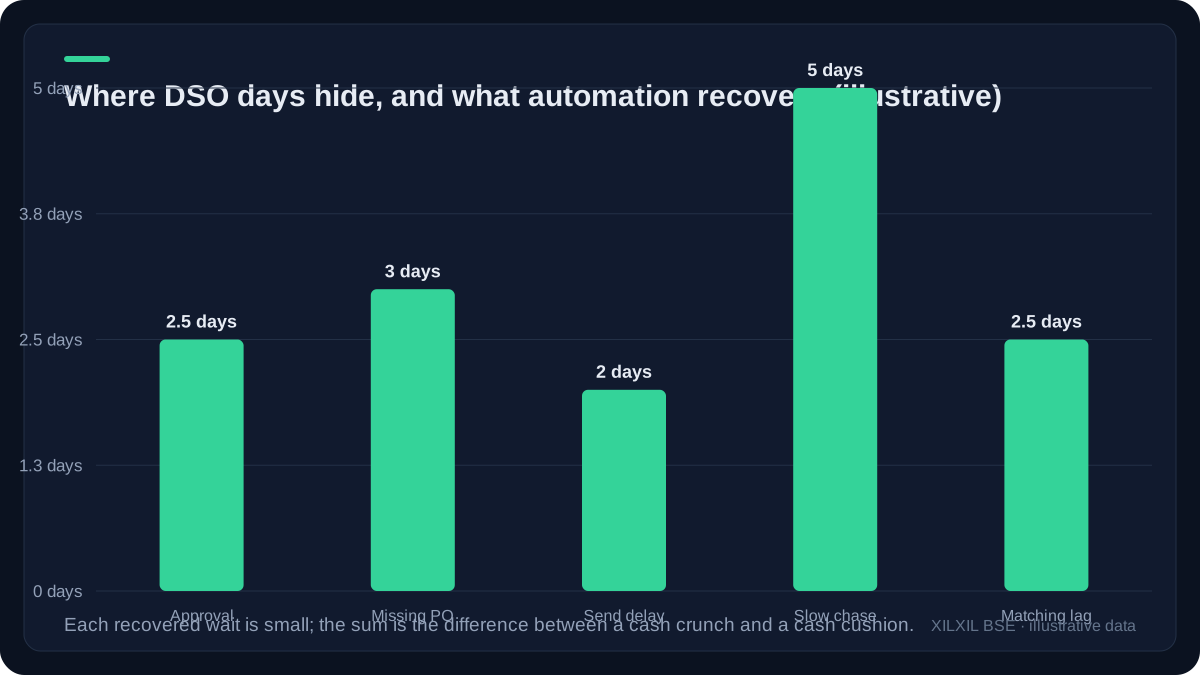
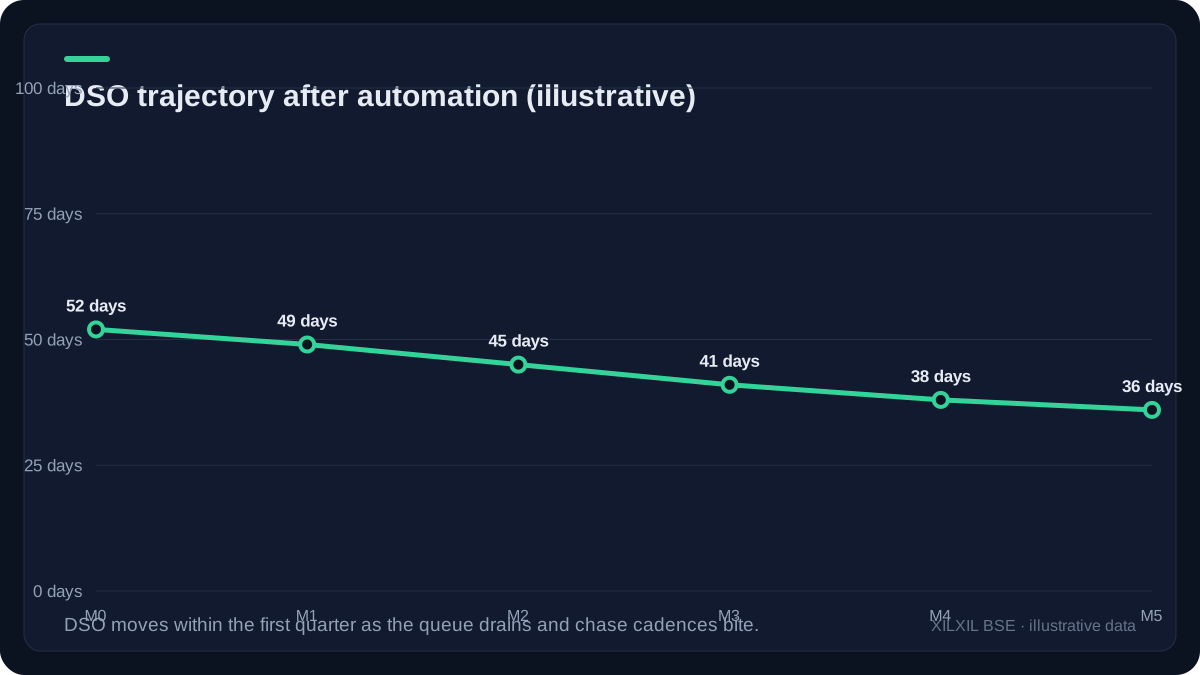
DSO is not one number — it is a queue of small waits, and every wait can be scheduled out of existence.
Key takeaways
- Trigger invoicing on delivery confirmation, not on memory.
- Block missing-PO sends before they bounce, not after.
- Match payments nightly; keep the human queue small and boring.
- Escalate chase cadence to match customer payment behaviour.
- Audit-log every automated action — finance adoption runs on the log.
Frequently asked questions
Which accounting systems do you connect to?
The common UAE stack is covered: Xero, QuickBooks, Zoho Books and SAP Business One, plus bank statement feeds. Where a system lacks an API, we automate the export/import path safely.
Does the AI touch the actual accounting entries?
No — matching and correspondence are automated; ledger entries follow your existing approval rules. The automation proposes, your controls dispose.
What about partial payments and deductions?
Rules cover the bulk; the genuinely ambiguous cases land in a short exception queue with the remittance context attached. Most teams clear it in under ten minutes a day.
How is this priced?
Fixed-scope build plus a small monthly run cost. Pricing lists the structure — the DSO reduction usually covers it before the second quarter.
Conclusion & next steps
That is the full picture: the context, the decisions, and the numbers behind invoice-to-cash. If one sentence should survive this read, it is this — preparation compounds. Measure the baseline, make the process legible, then automate deliberately and review monthly; that sequence works for finance leads in your books and everywhere else.
Want to see where your ten days are hiding? Contact for a free DSO teardown — bring your last quarter of invoices.
Picking tools for the job? Our honest, data-backed reviews live at Top AI Tools 2025 (SaaS & AI platforms) and Smart Home Picks (hardware worth the dirham) — illustrative benchmarks, clearly labelled, and never pay-to-play rankings.