
Onboarding is the same fifty steps every time — which is exactly why it should be automated. The new hire feels personal attention; the workflow does the chasing.
The flow that runs itself
Offer signed triggers everything: contracts generated from templates, accounts provisioned, equipment ordered, WPS payroll details collected through a secure form, training scheduled. Each step confirms to the new hire in their language.
- Day 0: signed offer → documents, accounts, equipment ordered
- Day −7: welcome pack, first-week calendar, buddy assigned
- Day 1: access works, laptop ready, training booked
- Day 30: pulse check → HR dashboard, not a spreadsheet
The HR data feeding this flow must be clean first — From Spreadsheet Chaos to Single Source of Truth is the prerequisite read. Privacy matters too: staff documents deserve the same treatment as Data Privacy for AI Workflows: A Dubai Business Checklist describes for customer data.
The landscape in numbers
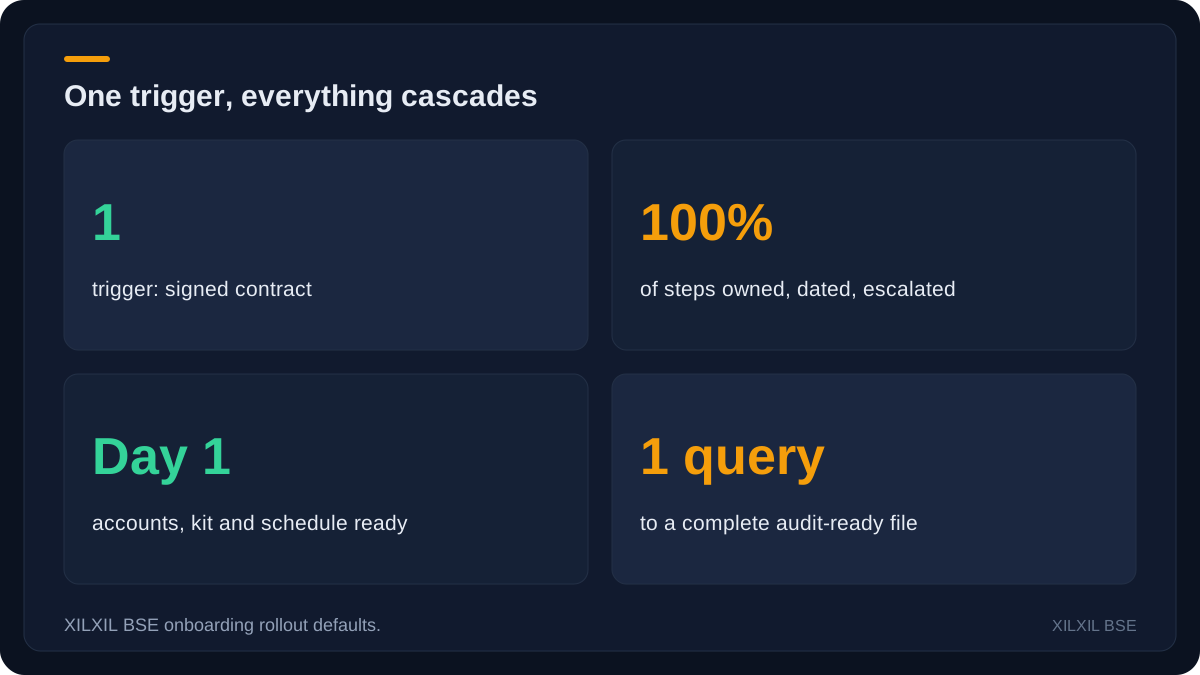
The panel below condenses HR onboarding into the figures that actually move decisions — the same ones we put on client dashboards. Every value here is a clearly-labelled illustrative industry figure; the operative numbers for your business come from the baseline we instrument before any build starts (Measuring Automation ROI: The Metrics That Matter explains that discipline).
First impressions are operational, not sentimental
A new hire’s first week is a series of small waits: the laptop that arrives Wednesday, the email account that exists Thursday, the checklist that lives in someone’s head. Each wait is a message about how the company runs. Automating the sequence is how you say “we are organised” without saying anything at all.
The pattern is a single trigger — signed contract — cascading into everything: IT ticket for equipment, account creation, payroll setup, workspace, buddy assignment, and a day-one schedule that is actually populated. Every step has an owner, a deadline and an escalation if it slips.
The paperwork layer, automated properly
Offers, contracts, ID verification, visa documents, policy acknowledgements — Gulf onboarding carries a document load that is easy to get half-wrong. The automated flow versions every template, tracks signatures, validates required fields before submission, and files everything against the employee record with an audit trail.
Compliance stops being a pre-audit panic. When inspection season arrives, the document set for any employee is one query away — complete, versioned and dated. The same structure makes audits boring, which is the highest compliment a compliance process can receive.
What HR does with the hours back
The honest goal of onboarding automation is not a smaller HR team; it is a better first month. Hours previously spent chasing signatures and laptop tickets move to the thirty-sixty-ninety day conversations that actually decide retention: expectations, feedback, growth paths.
Measure time-to-productive — the days until a new hire ships their first meaningful output. Teams typically cut it by a third within two quarters, not because people work faster but because nothing waits.
A rollout that survives contact with reality
Resist the big-bang. The sequence that works for HR onboarding: weeks one and two, run a small pilot on a single workflow with the old process still running alongside — the side-by-side comparison is the evidence that convinces everyone else. Weeks three and four, integrate with the surrounding systems and let the weekly review tune whatever the pilot exposed. From week six, scale to the rest of the team using the playbook the pilot produced.
Two guardrails keep the rollout honest. First, a named owner with the authority to change the process — automations without owners drift, and drift is how quiet failures start. Second, an explicit success metric agreed before the pilot begins, with the dashboard from Measuring Automation ROI: The Metrics That Matter keeping it visible from day one. With those two in place, scaling becomes a series of small, reversible decisions instead of one large bet.
The onboarding cascade, stage by stage
One trigger, six workstreams, every row owned and dated.
| Workstream | Triggered deliverables | Owner |
|---|---|---|
| IT & equipment | Laptop order, access badge, desk | IT coordinator |
| Accounts | Email, SSO, app access by role | IT + security |
| Documents | Contract, visa, policy sign-offs | HR operations |
| Payroll | Bank details, WPS registration | Payroll |
| Schedule | Week-one calendar, intros | Hiring manager |
| Buddy | Assigned, briefed, scheduled | Hiring manager |
The data, visualised
Charts beat adjectives. The figures below are drawn from the illustrative dataset behind this article — treat the shapes as the lesson, and replace the placeholder values with your own baseline when the work starts.
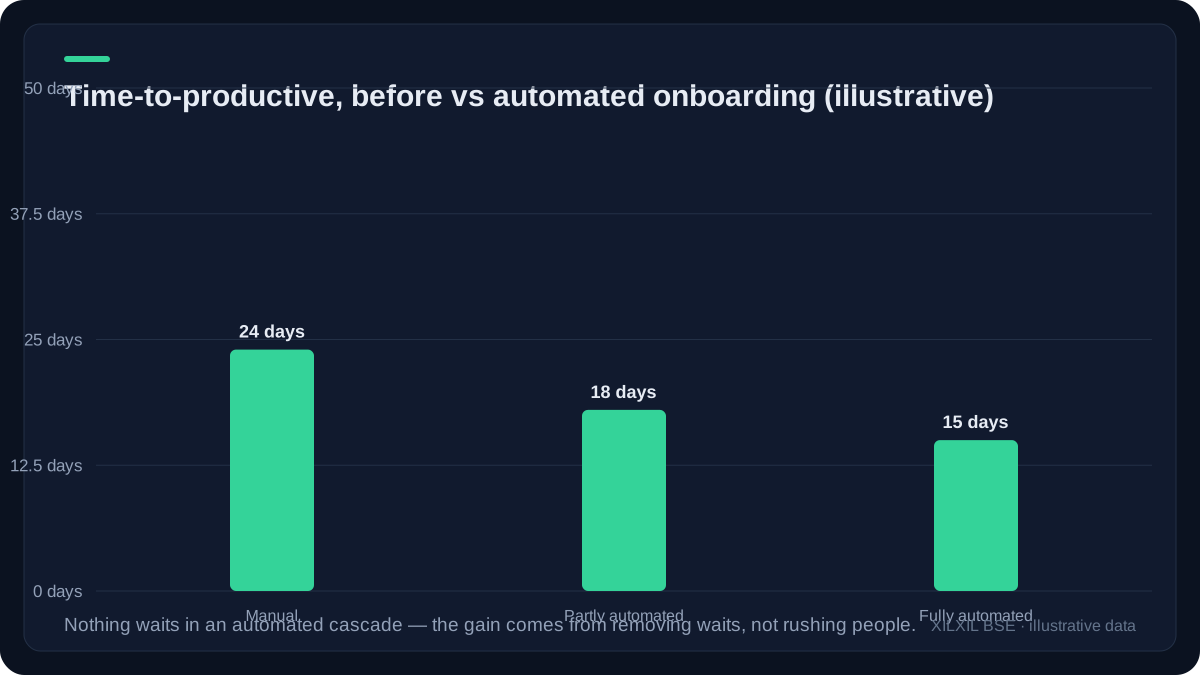
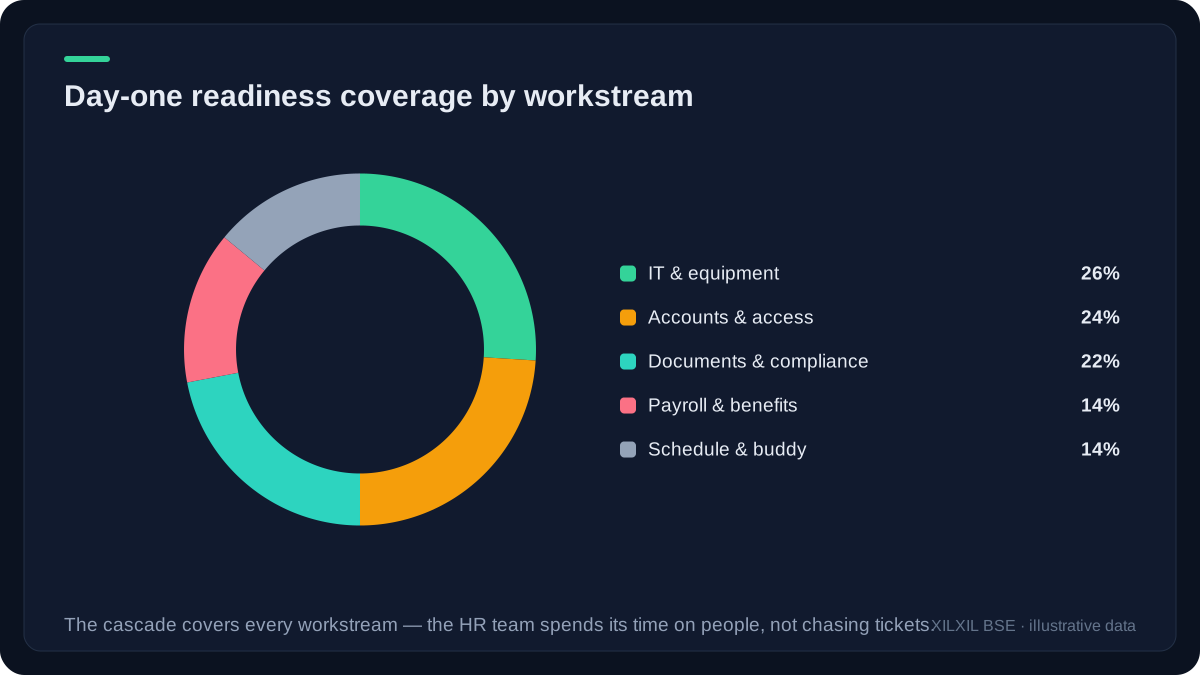
Every wait in week one is a message about how the company runs. Automation is how you say “we are organised”.
Key takeaways
- One trigger — signed contract — should cascade into every workstream automatically.
- Every onboarding step needs an owner, a deadline and an escalation path.
- Version and file documents against the employee record; audits become boring.
- Measure time-to-productive, not paperwork speed — the goal is a better first month.
- Spend the recovered hours on 30-60-90 conversations that drive retention.
Frequently asked questions
Does this replace our HR system?
No — it orchestrates around whatever HRIS you already run. The cascade creates the tickets, sends the documents and updates records; the system of record stays yours.
How do you handle UAE visa and labour-law documents?
As document flows with templates, validation and audit trails — the legal content stays under your PRO counsel’s control, while the chasing, filing and expiry alerts are automated.
What about offboarding?
The same cascade in reverse: access revocation, equipment return, final settlements and knowledge handover — with the same owners, dates and escalations.
How fast can we roll it out?
A fixed-scope build covers the six workstreams in about three weeks, then runs your next real hire as the pilot. Pricing lists what is included.
Conclusion & next steps
That is the full picture: the context, the decisions, and the numbers behind HR onboarding. If one sentence should survive this read, it is this — preparation compounds. Measure the baseline, make the process legible, then automate deliberately and review monthly; that sequence works for HR or people-ops leads in your team and everywhere else.
Got a joiner next month? Contact and we will show you the cascade running on a demo hire — before you commit.
Picking tools for the job? Our honest, data-backed reviews live at Top AI Tools 2025 (SaaS & AI platforms) and Smart Home Picks (hardware worth the dirham) — illustrative benchmarks, clearly labelled, and never pay-to-play rankings.