
Connecting an AI tool to customer data creates a data-flow decision, whether or not anyone made it deliberately. Under the UAE’s personal data protection law, that decision is yours to get right. This checklist keeps it simple.
Before any data flows
- Map it: which fields, which systems, which country do they land in
- Minimise: the agent needs a phone number, not a life history
- Consent: chat and call agents disclose they are AI, upfront
- Retention: transcripts and logs expire on a schedule you set
- Vendors: where is processing done, is training opted out
Self-hosting changes the calculus
Self-hosted n8n and on-region models keep data inside infrastructure you control — the reason we default to it for sensitive flows, as covered in n8n vs Zapier vs Make: Choosing Your Automation Backbone. Bilingual consent copy matters as well; Arabic-First Chatbots: Designing for Bilingual Customers shows the disclosure patterns.
Privacy review is part of every build we hand over — documented, not promised. Questions about a specific flow? Contact and we will walk your data map.
The landscape in numbers
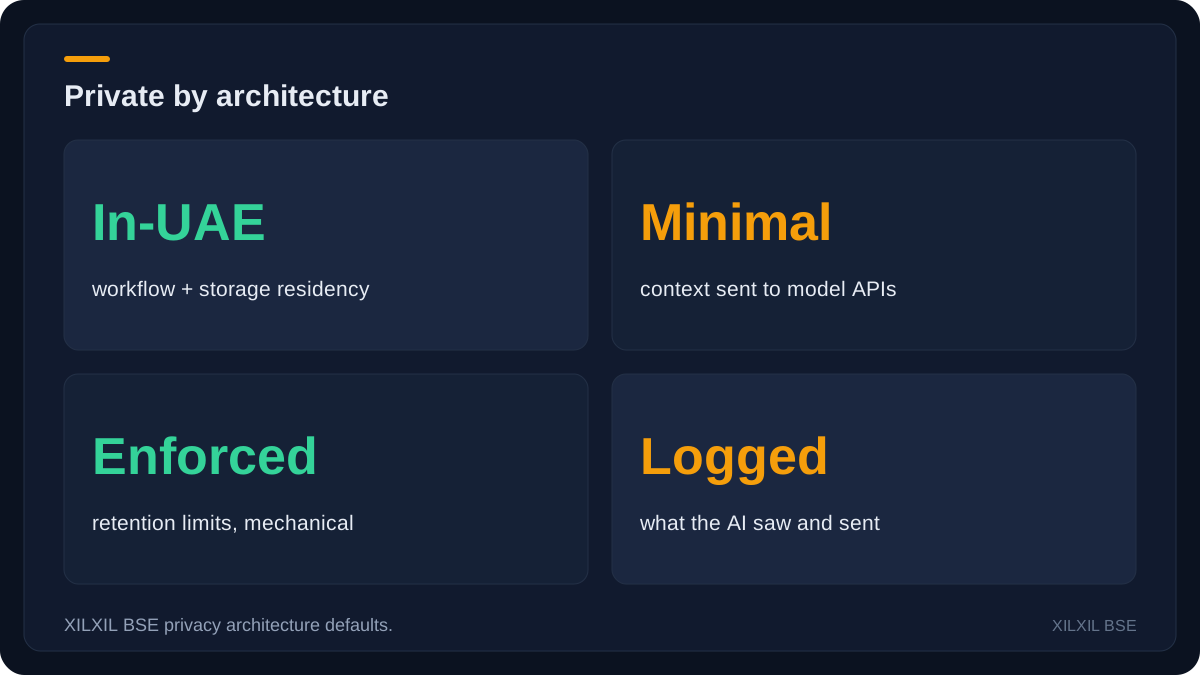
The panel below condenses data privacy in AI workflows into the figures that actually move decisions — the same ones we put on client dashboards. Every value here is a clearly-labelled illustrative industry figure; the operative numbers for your business come from the baseline we instrument before any build starts (Measuring Automation ROI: The Metrics That Matter explains that discipline).
The UAE legal map, briefly
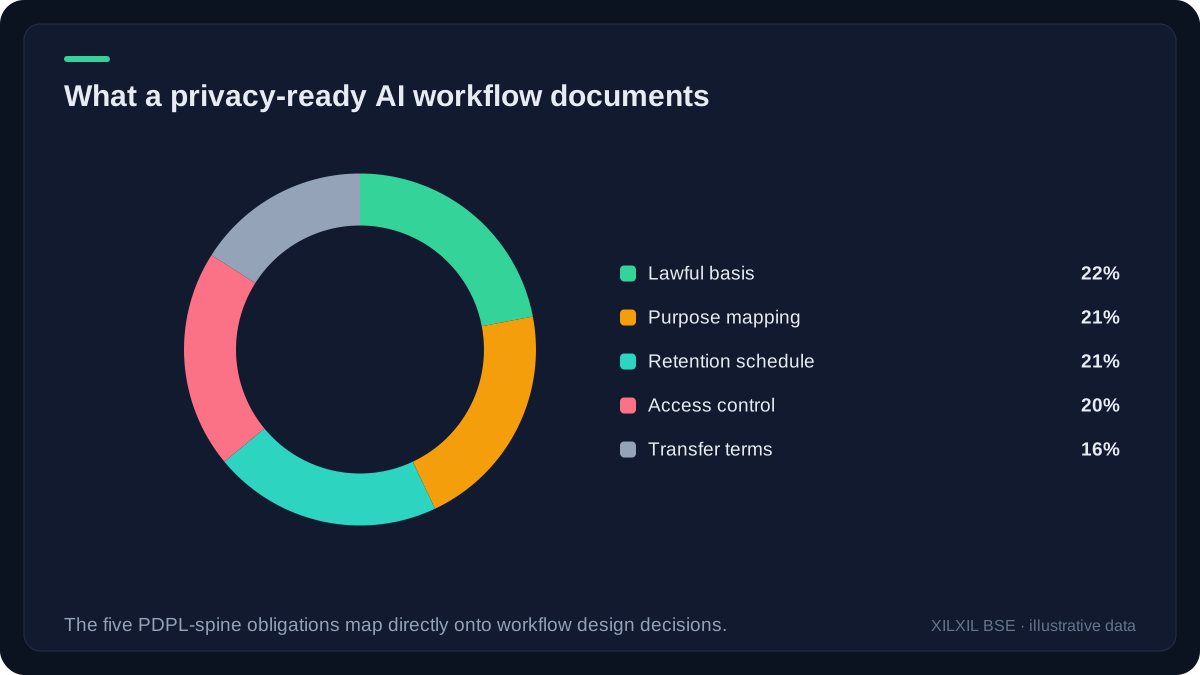
Three regimes matter for most UAE businesses: the federal PDPL for onshore personal data, the DIFC and ADGM data protection laws for financial-free-zone entities, and sector rules (health, banking) on top. They share a spine: lawful basis, purpose limitation, data-subject rights, breach notification, and cross-border transfer conditions.
AI workflows touch all five. A chatbot ingesting support tickets processes personal data; a summarisation model sending text to an overseas API is a cross-border transfer; an agent that remembers customers needs retention limits. None of this forbids AI — it demands the workflow be designed with the data map in hand.
Practical architecture: keep the data home
The highest-leverage default is architectural: self-host the workflow engine (n8n on your infrastructure), keep documents and vectors in your own database, and send only the minimal necessary context to model APIs. Where the model must see sensitive text, use redaction layers, enterprise endpoints with no-training guarantees, or regional model hosting where available.
UAE data residency is often a board-level question. The honest answer we give: the workflow and storage can live entirely in-country; the model inference point is the decision to engineer deliberately — with contracts, technical limits and documentation, not vibes.
Consent, retention and the audit trail
Design the data lifecycle before the demo: what enters the workflow, what is retained, for how long, and who can see it. Consent text that covers AI processing, retention schedules enforced mechanically (expired vectors are deleted, not archived), and an audit log answering “what did the AI see and send” for any past interaction.
That log is your friend in three conversations: a regulator’s question, a customer’s subject-access request, and your own quarterly review. Workflows that cannot answer those questions are not ready for personal data — however impressive the demo was.
A rollout that survives contact with reality
Resist the big-bang. The sequence that works for data privacy in AI workflows: weeks one and two, run a small pilot on a single workflow with the old process still running alongside — the side-by-side comparison is the evidence that convinces everyone else. Weeks three and four, integrate with the surrounding systems and let the weekly review tune whatever the pilot exposed. From week six, scale to the rest of the team using the playbook the pilot produced.
Two guardrails keep the rollout honest. First, a named owner with the authority to change the process — automations without owners drift, and drift is how quiet failures start. Second, an explicit success metric agreed before the pilot begins, with the dashboard from Measuring Automation ROI: The Metrics That Matter keeping it visible from day one. With those two in place, scaling becomes a series of small, reversible decisions instead of one large bet.
Quick privacy gate for any AI workflow
Run every new workflow through these five questions before it touches real data.
| Question | Green answer | Red flag |
|---|---|---|
| What personal data enters? | Named fields, minimised | “Everything in the inbox” |
| Where is it processed? | Documented, residency-aware | Undocumented third-party tool |
| What is retained? | Schedule, mechanically enforced | “We keep it all, just in case” |
| Who can see outputs? | Role-based, logged | Whole company, no log |
| What leaves to APIs? | Redacted minimal context | Full transcripts by default |
The data, visualised
Charts beat adjectives. The figures below are drawn from the illustrative dataset behind this article — treat the shapes as the lesson, and replace the placeholder values with your own baseline when the work starts.
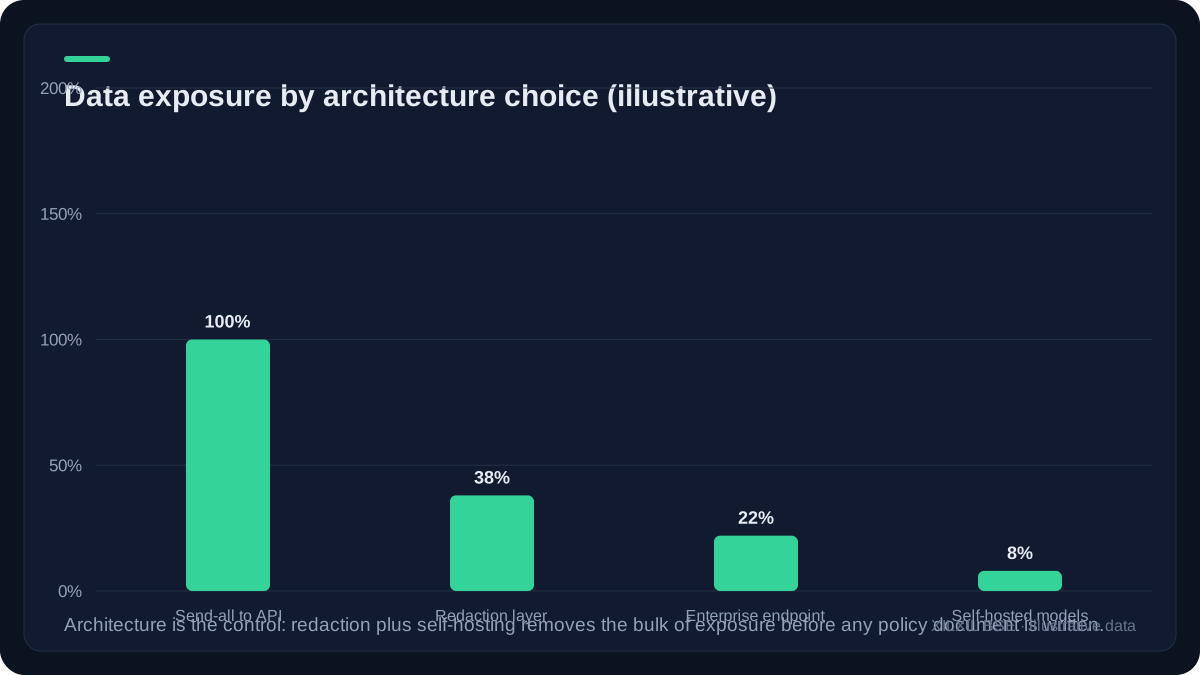
Architecture is the privacy control: what never leaves your infrastructure cannot leak from it.
Key takeaways
- PDPL / DIFC / ADGM share a spine — lawful basis, purpose, rights, breach, transfers.
- Self-host the workflow engine; keep documents and vectors on your infrastructure.
- Redaction layers and enterprise endpoints for anything sensitive that must reach a model.
- Retention limits enforced mechanically — expired data is deleted, not archived.
- The audit log (what the AI saw and sent) answers regulators, customers and you.
Frequently asked questions
Is using overseas AI APIs lawful in the UAE?
It can be, with the right conditions: transfer assessments, contractual protections and minimisation. Our architecture reviews make those conditions explicit rather than assumed.
Do self-hosted models mean weaker answers?
For grounded business tasks (classification, extraction, RAG over your documents), self-hosted or regional models are routinely sufficient — and the privacy win is structural.
What about employee monitoring use cases?
Treat them as high-risk: explicit lawful basis, works-council-style transparency, proportionality review. We scope them only with those guards in place.
Can you audit an existing AI workflow?
Yes — a fixed-scope review produces the data map, exposure points and a prioritised remediation list. Contact books it; Pricing shows scope.
Conclusion & next steps
That is the full picture: the context, the decisions, and the numbers behind data privacy in AI workflows. If one sentence should survive this read, it is this — preparation compounds. Measure the baseline, make the process legible, then automate deliberately and review monthly; that sequence works for compliance or IT leads in the UAE and everywhere else.
Planning an AI workflow that touches personal data? Contact for the privacy-first architecture review — before the demo, not after.
Picking tools for the job? Our honest, data-backed reviews live at Top AI Tools 2025 (SaaS & AI platforms) and Smart Home Picks (hardware worth the dirham) — illustrative benchmarks, clearly labelled, and never pay-to-play rankings.