

The pattern is always the same: sales keeps one sheet, operations another, finance a third — and one day a month disappears into reconciling them. The way out is not a bigger spreadsheet; it is one system of record with automation feeding it.
The incremental path
- Week 1: pick ONE data type — customers, orders or inventory
- Week 2: build the single table and import the three versions
- Week 3: freeze the old sheets (view-only) and route edits to the source
- Week 4: automations read from the source — reporting heals itself
Big-bang migrations fail because everything changes at once. One data type per month compounds quietly — the same philosophy as the 90-day plan in Scaling Support Without Scaling Headcount: A 90-Day Plan. Clean data then unlocks scoring, RAG and forecasting: Lead Qualification on Autopilot: Scoring and Routing with AI is a natural next step.
We run these consolidations as fixed-scope monthly engagements. The first workshop is free — Contact.
The landscape in numbers
The panel below condenses spreadsheet chaos into the figures that actually move decisions — the same ones we put on client dashboards. Every value here is a clearly-labelled illustrative industry figure; the operative numbers for your business come from the baseline we instrument before any build starts (Measuring Automation ROI: The Metrics That Matter explains that discipline).
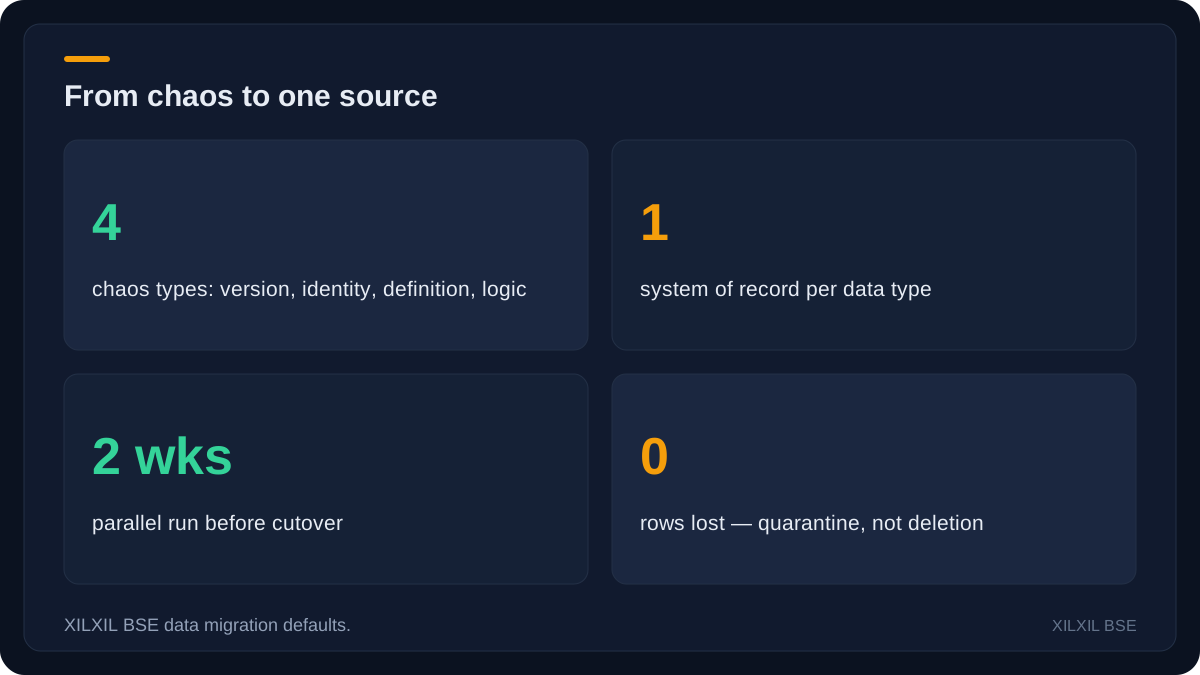
The taxonomy of spreadsheet chaos
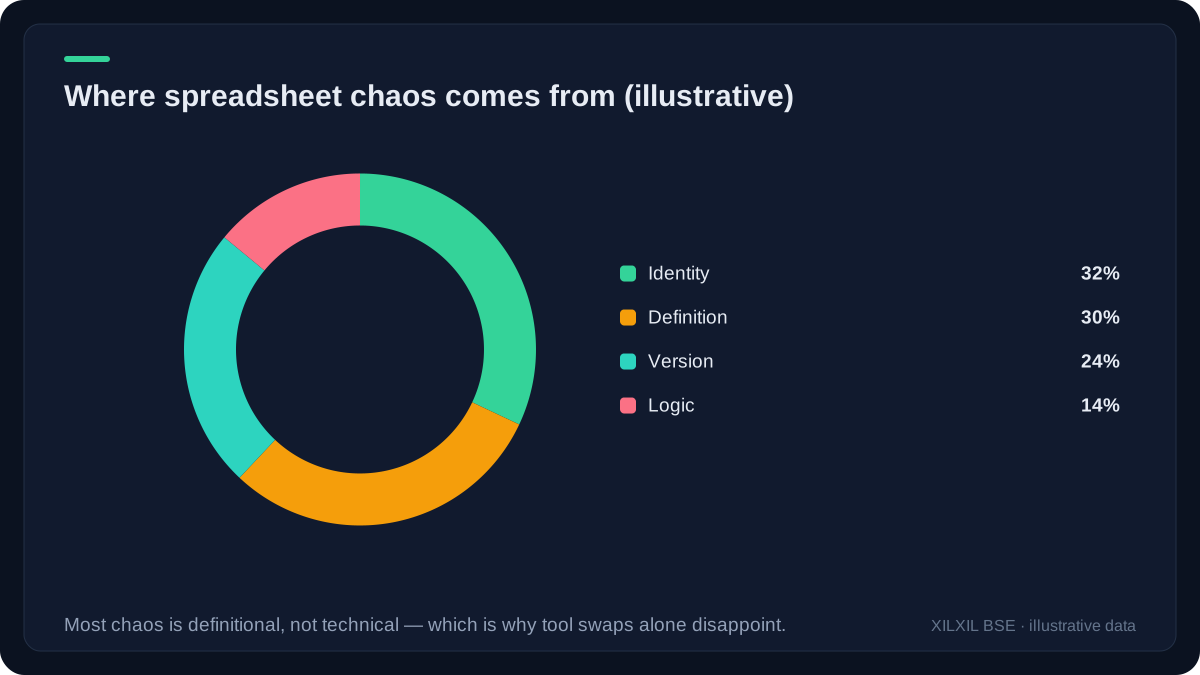
Chaos has a structure, and naming it is half the fix. Version chaos: final_v3_REAL_final.xlsx emailed at 4:58pm Friday. Identity chaos: the same customer as three spellings across four sheets. Definition chaos: “revenue” that means bookings to sales, invoiced to finance, and cash-collected to nobody. Logic chaos: a formula referencing a row someone inserted in 2022.
Each type has a different cure, which is why “move everything to a database” projects disappoint — they fix storage while leaving definitions and identities exactly as broken as before. Cure the taxonomy first; the tooling change then becomes almost boring.
One system of record per data type
The single most valuable sentence in data operations: every data type gets exactly one system of record, and every other tool defers to it. Customers live in the CRM. Orders live in the ops platform. The rule is not “no spreadsheets” — it is “no spreadsheet is the source”. Spreadsheets become views and analyses, never authorities.
Enforcement is mechanical: views pull from the record system on a schedule, edits flow back through forms with validation, and the record system’s audit log becomes the history nobody had to keep. The first month feels slower than copy-paste. The second month is when nobody argues anymore.
The migration that does not stall
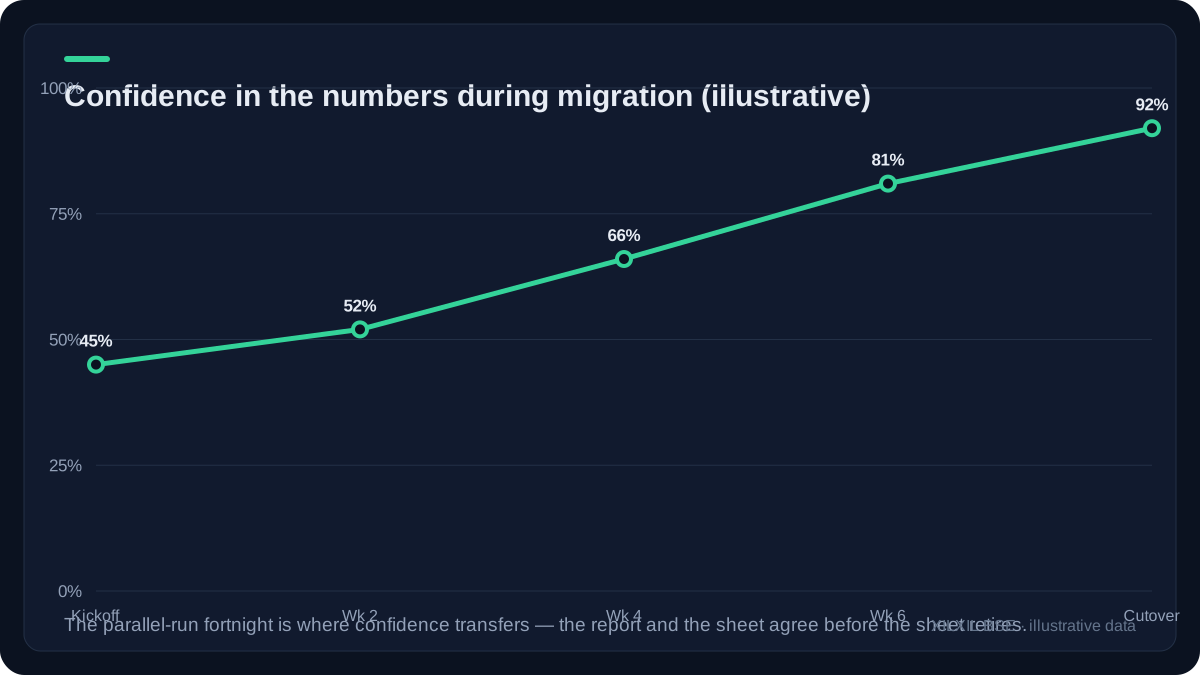
Migrations stall on the impossible 10 percent: the legacy rows that nobody can reconcile. The pragmatic sequence — pick the highest-chaos data type, freeze its spreadsheets, migrate with a reconciliation report that quarantines (not fixes) the unmatched rows, run the record system in parallel for two weeks, then archive the sheets read-only.
Quarantine is the psychological unlock. Teams block migrations because they fear losing the messy rows that “someone will need”. Quarantined rows stay visible, owned and datable — they just stop corrupting the live truth while they are resolved.
A rollout that survives contact with reality
Resist the big-bang. The sequence that works for spreadsheet chaos: weeks one and two, run a small pilot on a single workflow with the old process still running alongside — the side-by-side comparison is the evidence that convinces everyone else. Weeks three and four, integrate with the surrounding systems and let the weekly review tune whatever the pilot exposed. From week six, scale to the rest of the team using the playbook the pilot produced.
Two guardrails keep the rollout honest. First, a named owner with the authority to change the process — automations without owners drift, and drift is how quiet failures start. Second, an explicit success metric agreed before the pilot begins, with the dashboard from Measuring Automation ROI: The Metrics That Matter keeping it visible from day one. With those two in place, scaling becomes a series of small, reversible decisions instead of one large bet.
The four chaos types and their cures
Diagnose before you migrate — each type has a different first move.
| Chaos type | Symptom | Cure |
|---|---|---|
| Version | “Which file is current?” | Record system + scheduled views |
| Identity | Same customer, three spellings | Deterministic IDs + merge rules |
| Definition | “Revenue” means three things | Written metric definitions |
| Logic | Formula breaks every quarter | Validation + logic in the record system |
The data, visualised
Charts beat adjectives. The figures below are drawn from the illustrative dataset behind this article — treat the shapes as the lesson, and replace the placeholder values with your own baseline when the work starts.
The rule is not “no spreadsheets” — it is “no spreadsheet is the source”.
Key takeaways
- Name the chaos: version, identity, definition, logic — each has its own cure.
- One system of record per data type; spreadsheets become views, never authorities.
- Migrate the highest-chaos type first, with quarantine for unreconcilable rows.
- Run in parallel for two weeks; retire sheets read-only, never delete.
- Written metric definitions outlive every tool you will ever use.
Frequently asked questions
Do we have to stop using Excel?
No — Excel stays as the analysis surface it is brilliant at. The change is constitutional: it stops being the source of record, and everything it shows is pulled from the system that is.
Which platform should be the system of record?
The one your team already trusts for that data type — CRM for customers, your ops platform for orders. The migration is about authority and hygiene, not a specific brand.
How do you handle the scary legacy rows?
Quarantine: unmatched rows land in a visible, owned, dated review queue instead of blocking the migration or corrupting the live data. Most clear within weeks.
Is this a prerequisite for automation?
For any automation touching that data — yes. Automation Readiness Checklist scores exactly this; cleaning sources first is the cheapest de-risking there is.
Conclusion & next steps
That is the full picture: the context, the decisions, and the numbers behind spreadsheet chaos. If one sentence should survive this read, it is this — preparation compounds. Measure the baseline, make the process legible, then automate deliberately and review monthly; that sequence works for operations managers in your operations and everywhere else.
Drowning in final_v3_REAL_final? Contact for a free data-map session — Pricing shows the fixed-scope migration.



1 comment